


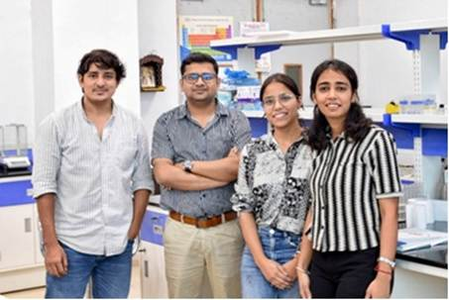
New Delhi, Sep 8 : While cholesterol, the fat-like substance, has typically been related to heart diseases, scientists from the Institute of Nano Science and Technology (INST), Mohali, an autonomous institute of the Department of Science and Technology (DST), showed its potential to power next-generation spintronic devices.
The team introduced cholesterol-based nanomaterials as novel platforms for future quantum technologies and spintronic applications. “Cholesterol can be used to control the spin of electrons — an invisible quantum property that could contribute to the development of energy-efficient next-generation spintronic devices. This is because it enables precise control over molecular properties due to its intrinsic handedness (chirality) and flexibility,” said the INST team, led by Dr. Amit Kumar Mondal. The study showed that cholesterol-based nanomaterials can manipulate the spin of electrons — a quantum feature critical for the next generation of electronics. By combining metal ions with the organic framework, the scientists showed how well a material can separate electrons based on their magnetic “spin” orientation by adjusting the kind and concentration of metal ions. By combining cholesterol with different metal ions, the researchers created nanomaterials that selectively filter electron spins. Interestingly, both spin directions could be controlled within a single system.