TV Audience in India to Touch 1 Billion by 2029: Indian Institute of Management Ahmedabad Report
Bilkul Online
Rural India to Power Next Phase of TV Viewership Growth
Bilkul Online
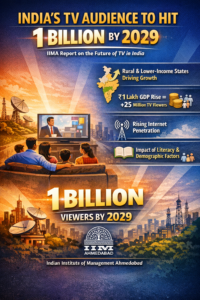
Ahmedabad | 24 Jan 2026 India’s television universe is set for a historic expansion, with the country’s TV audience projected to cross 1 billion viewers by 2029, according to The Future of TV in India report released by Indian Institute of Management Ahmedabad (IIMA).
Authored by IIMA professors Viswanath Pingali and Ankur Sinha, the report highlights how rising incomes, improving literacy levels, and expanding internet penetration are collectively driving sustained growth in television consumption across the country.
Key Findings from the Report:
India’s TV audience is expected to grow at a steady annual rate of 2–3%, reaching nearly 1.03 billion viewers by 2029.
Rural and lower-income states will be the primary growth engines, with TV penetration levels projected to match those of today’s higher-income states by the end of the decade.
In states with per capita income below the national average, a ₹1 lakh increase in per capita GDP could translate into an additional 25 million TV viewers.
Internet penetration has emerged as a significant driver of television growth, underscoring the complementary relationship between digital connectivity and TV consumption.
Literacy rates and dependency ratios play a critical role in influencing television adoption, particularly in rural India.
The study employs a robust statistical regression framework, analysing variations in television viewership across states over multiple years. It evaluates key indicators such as internet subscribers, Gross State Domestic Product (GSDP) per capita, literacy levels, dependency ratios, income distribution, and access to micro-credit.
“As a mature yet evolving medium, television continues to play a pivotal role in India’s socio-economic development,” said Prof. Viswanath Pingali. “Rising incomes and improving literacy—especially in rural and lower-income regions—are creating a multiplier effect that significantly boosts TV adoption and consumption.”
Prof. Ankur Sinha added, “Our analysis shows that internet access, demographic composition, and income growth interact in powerful ways. The state-wise projections clearly indicate that the next phase of television growth will be driven by regions undergoing rapid socio-economic transformation.”
Beyond viewership numbers, the report also points to television’s broader social impact. Exposure to TV content—particularly through same-language subtitling—has been linked to improved literacy, greater awareness of personal autonomy, enhanced financial independence, and more progressive gender attitudes.
By integrating economic, demographic, and digital indicators into a forward-looking audience estimation model, the IIMA report offers strong academic validation of television’s enduring relevance in India’s rapidly changing media ecosystem.