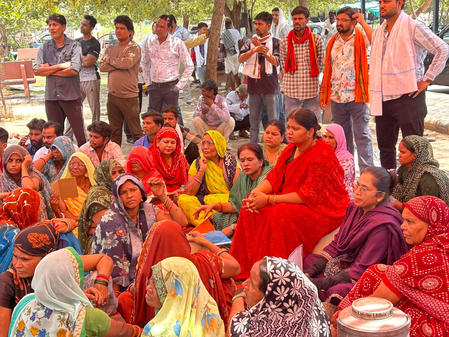
Seven mothers dead, one injection under scanner; Rajasthan’s Oxytocin tragedy triggers national action
Bilkul Online
Jaipur |
What began as a series of unexplained maternal deaths in Rajasthan has now snowballed into a nationwide drug safety investigation. Seven women, who had recently given birth, lost their lives over a span of less than two months, prompting the Union Health Ministry to cancel the manufacturing licence of the company producing the Oxytocin injection suspected to be linked to the cases.
The World Health Organisation (WHO) has also stepped in, seeking a detailed report from the Indian government. The action follows investigations into the quality of ‘TOCIN’ (Oxytocin Injection 5 ml) manufactured by M/s Jackson Laboratories Private Limited in Amritsar. Laboratory analysis by the Rajasthan Drug Control Department found that the sample failed to meet quality standards because it did not contain the prescribed quantity of the active Oxytocin ingredient. Acting on these findings, the CDSCO inspected the company’s manufacturing units in Punjab and Himachal Pradesh and recommended the cancellation of its manufacturing licence, a recommendation subsequently accepted by the Union Health Ministry.
The Ministry has also sought a comprehensive report from the Rajasthan government. At the same time, the WHO has asked India whether similar incidents have occurred elsewhere and what corrective measures are being taken. The women whose deaths are under investigation include Payal (New Medical Hospital at Kota on May 5), Jyoti (May 7), Priya Mahawar (J.K. Lon Hospital at Kota on May 9), Pinki Mahawar (May 10), Shireen (New Medical Hospital at Kota on May 17), Preeti (PBM Hospital at Bikaner on June 19) and Sharda Nayak (PBM Hospital at Bikaner on June 21). As questions mounted over the deaths, investigators focused on medicines administered during delivery, particularly the ‘TOCIN’ (Oxytocin Injection 5 ml) manufactured by M/s Jackson Laboratories Private Limited in Amritsar. Laboratory analysis conducted by the Rajasthan Drug Control Department found that the sample failed to meet quality standards because it did not contain the prescribed quantity of the active ingredient, Oxytocin. The Ministry has also sought a detailed factual report from the Rajasthan government as part of a wider investigation.
The case has drawn international attention because Oxytocin is among the most critical medicines used in maternity care across the world. It is routinely administered to induce labour when childbirth does not begin naturally, to control excessive bleeding after delivery, one of the leading causes of maternal mortality and to help manage incomplete miscarriages by contracting the uterus. Since the drug is used during life-saving procedures, any compromise in its quality can have serious consequences for both mothers and newborns. The WHO’s intervention has extended beyond Rajasthan, with the global health body seeking details on whether similar incidents have occurred elsewhere in India and whether defective batches were distributed outside the state.
Authorities are now examining supply chains, batch distribution records and hospital procurement systems to determine the full extent of the issue. The investigation is expected to establish whether the maternal deaths were directly linked to the substandard drug and whether additional regulatory action is required to strengthen quality surveillance of essential medicines used in public healthcare facilities, officials said.