


The Man Who Refused to Let a Mountain Decide His Destiny
- Bilkul Online | Sunday Special
- By Rafat Quadri (Editor)
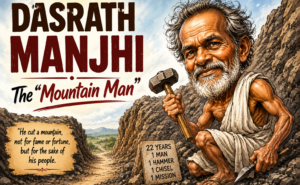

The Man Who Refused to Let a Mountain Decide His Destiny
There are heroes who win wars, build empires or create billion-dollar companies. Then there are heroes who quietly change the lives of ordinary people with nothing more than determination, courage and an unbreakable will. Dashrath Manjhi belongs to the second category.
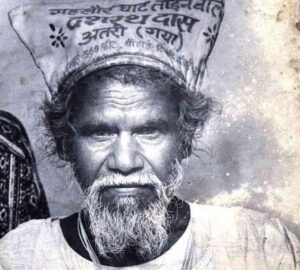
Known across India as the “Mountain Man,” Dashrath Manjhi achieved what many considered impossible. Armed with only a hammer and a chisel, he spent 22 years cutting through a massive hill in Bihar to create a road connecting his isolated village with nearby towns.
His achievement was not backed by government funding, machinery or engineers. It was powered by grief, love and an unwavering belief that ordinary people can accomplish extraordinary things.
A Village Trapped by a Mountain
Dashrath Manjhi was born in 1934 in Gehlaur village, located in present-day Gaya district of Bihar. The village was separated from nearby towns by a rocky mountain belonging to the Gehlour Hills.
For generations, villagers had to walk around the hill to reach schools, hospitals, markets and government offices. The journey, often exceeding 50 kilometres, consumed valuable time and sometimes cost lives during medical emergencies.
The mountain had become more than a geographical barrier—it symbolized poverty, neglect and social inequality.
The Tragedy That Changed Everything
The defining moment of Manjhi’s life came in 1959.
According to widely accepted accounts, his wife Falguni Devi was bringing food to him while he worked in the fields. While crossing the rocky hillside, she slipped, suffered severe injuries and could not receive timely medical treatment because the nearest hospital was too far away.
Her death devastated Dashrath Manjhi.
Instead of accepting fate, he made an astonishing decision.
He would carve a road through the mountain himself.
Most people dismissed the idea as madness.
He never listened.
A Hammer, A Chisel and an Impossible Dream
Twenty-Two Years Later, History Was Written
In 1982, after 22 years of relentless effort, Dashrath Manjhi accomplished what experts would have considered nearly impossible.
He carved a passage approximately:
The new road dramatically reduced the distance between Gehlaur and nearby towns from around 55 kilometres to nearly 15 kilometres.
For thousands of villagers, education, healthcare and markets suddenly became significantly more accessible.
One man’s determination permanently transformed an entire region.
More Than a Road
The Lesser-Known Story: He Wanted Roads, Not Rewards
Why Society Initially Ignored Him
His life therefore raises an important question: Should individuals have to perform miracles to obtain basic public infrastructure?
National Recognition Came Late
After his death from cancer on 17 August 2007, he was accorded a state funeral by the Bihar government—an extraordinary honour for a man who had once been dismissed as a dreamer.
Cinema Brought His Story to Millions
In 2015, filmmaker Ketan Mehta brought Manjhi’s inspiring journey to the silver screen in the biographical film Manjhi: The Mountain Man, starring Nawazuddin Siddiqui in one of the most acclaimed performances of his career.
The film introduced a new generation to a man whose greatest achievement required no special effects—only extraordinary perseverance.
Leadership Lessons from the Mountain Man
Dashrath Manjhi’s life offers timeless lessons:
Legacy That Lives Beyond Stone
He carved a message into the conscience of India: No obstacle is bigger than human determination when it is driven by purpose.
Dashrath Manjhi at a Glance
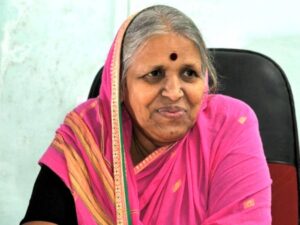
The Woman Behind the Legend
Before India came to know Dashrath Manjhi as the “Mountain Man,” he was simply a loving husband devoted to his wife, Falguni Devi. Born into extreme poverty, the couple built a modest life in Gehlaur village, relying on agricultural labour to support their family. They were blessed with a son, Bhagirath Manjhi, and a daughter Laungi Devi.
Those who knew them recalled that Falguni often walked long distances to bring food and water to her husband while he worked in the fields. It was during one such journey that she suffered the injuries that ultimately claimed her life because medical help was far beyond the mountain and could not be reached in time. Her death was not merely a personal tragedy—it became the turning point that transformed an ordinary labourer into one of India’s greatest symbols of determination.
Even after Falguni’s passing, Dashrath continued raising his children while pursuing the seemingly impossible task of carving a road through solid rock. His son, Bhagirath Manjhi, has since worked to preserve his father’s legacy and has represented the family’s continued struggle for development and recognition in Gehlaur.
(Designed with AI)


