


Some people write songs. Some write poems. Some make films. Gulzar has spent a lifetime doing all three—and turning ordinary words into extraordinary emotions
- Bilkul Online | Sunday Special
- By Rafat Quadri (Editor)
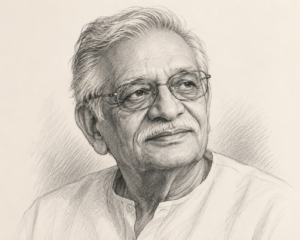

Some people write songs. Some write poems. Some make films. Gulzar has spent a lifetime doing all three—and turning ordinary words into extraordinary emotions
Full name: Sampooran Singh Kalra
Popular name: Gulzar
Born: August 18, 1934
Fields: Poetry, literature, lyrics, screenwriting, filmmaking and television
Major honours: Sahitya Akademi Award, Padma Bhushan, Academy Award, Grammy Award, Dadasaheb Phalke Award and Jnanpith Award
Academy Award: Best Original Song for Jai Ho, Slumdog Millionaire
Known for: Poetry that blends simplicity, imagery and profound human emotion
Born Sampooran Singh Kalra on August 18, 1934, in Dina in the Jhelum district of undivided Punjab, Gulzar grew up to become one of India’s most celebrated poets, lyricists, writers and filmmakers. His creative journey has crossed the worlds of Hindi cinema, Urdu and Hindi poetry, literature and television.
The upheaval of Partition became an important backdrop to Gulzar’s early life. After Partition, his family moved to India, and the young Sampooran eventually found his way to Mumbai.
His literary instincts eventually brought him into the film world. He began working with filmmaker Bimal Roy and got his major break as a lyricist with Bandini in 1963. From that beginning emerged a career that would redefine what a film song could express.
Gulzar’s greatest gift has perhaps been his ability to say complex things simply.
His lyrics often do not merely describe love, separation, loneliness, nature or relationships—they create an atmosphere around them. He introduced unusual imagery, conversational language and poetic metaphors into popular cinema without making them inaccessible to ordinary audiences.
His collaborations with legendary composers and singers produced songs that remain deeply embedded in India’s cultural memory.
For Gulzar, a song was never simply a song. It was another form of storytelling.
To describe Gulzar merely as a lyricist would be to overlook much of his contribution.
He became a screenwriter, dialogue writer, poet, filmmaker and author, directing films such as Mere Apne, Koshish, Aandhi, Mausam, Khushboo, Angoor, Meera, Lekin and Maachis. He also created acclaimed television works, including Mirza Ghalib and Tahreer Munshi Premchand Ki.
His films were often marked by sensitivity rather than spectacle. Relationships, human loneliness, social realities and the complexity of ordinary lives became his subjects.
Gulzar’s literary identity is as important as his cinematic one.
Writing primarily in Hindi, Urdu and Punjabi, he has created poetry, short stories, children’s literature and translations. He also developed Triveni, a distinctive three-line poetic form that became closely associated with his literary work. The Jnanpith Trust describes him as a major figure in both film and literature.
His writing has a recognisable quality: a few carefully chosen words can open an entire emotional landscape.
That may be the secret of Gulzar’s longevity. He does not try to overwhelm the reader. He leaves space for the reader to feel.
One of the most remarkable chapters in Gulzar’s career came with Slumdog Millionaire.
His lyrics for “Jai Ho,” composed by A.R. Rahman, won the Academy Award for Best Original Song at the 81st Academy Awards in 2009. The Academy records Gulzar as the lyricist and A.R. Rahman as the composer.
The song subsequently won a Grammy Award as well.
For an Indian poet and lyricist, it was a remarkable moment: words born from the Indian literary and cinematic tradition had reached the world’s biggest film stage.
Gulzar’s achievements have been recognised at both national and international levels.
He received the Sahitya Akademi Award in 2002, the Padma Bhushan in 2004, the Academy Award in 2009, and the Grammy Award in 2010. In 2013, he was selected for the Dadasaheb Phalke Award, India’s highest honour for lifetime contribution to Indian cinema.
His literary journey reached another landmark when he was named a recipient of the 58th Jnanpith Award, India’s highest literary honour, for 2023.
Gulzar’s greatness lies not merely in the number of awards he has received or the number of songs, poems and films he has created.
It lies in his ability to connect literature with popular culture.
He made poetry part of everyday life. He brought literary sensitivity into commercial cinema. He showed that a film song could be simple enough to hum and deep enough to contemplate.
Across seven decades, generations have grown up listening to his words, watching his films and discovering his poetry.
And perhaps that is the most enduring measure of a creative person’s greatness—not how many awards sit on a shelf, but how many hearts remember the words.
Gulzar’s words have lived in songs, poems, films and memories. And in doing so, they have become a part of India’s cultural inheritance.
As Gulzar Sahab’s birthday falls on August 18, just two days away, BILKUL ONLINE and its readers join in wishing the legendary poet, lyricist, writer and filmmaker a very Happy Birthday, with wishes for many more years of creativity, poetry and inspiration.
The Great Indians | Bilkul Online
Celebrating Indians whose work has shaped the way we think, create, build and live. You can also suggest names of individuals/institutions present or past.
Note: We seek Sponsors for this column. Please connect with us at infobilkul@gmail.com
