


Dhirubhai Ambani (1932–2002)
Entrepreneur | Industrialist | Founder of Reliance
- Bilkul Online | Sunday Special
- By Rafat Quadri (Editor)
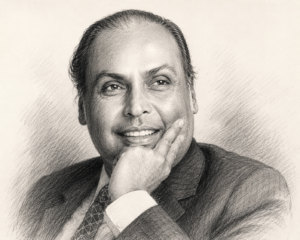

Dhirubhai Ambani (1932–2002)
Entrepreneur | Industrialist | Founder of Reliance
His journey in one line
From a small-town boy in Gujarat to one of the men who changed the face of Indian business.
From a modest beginning in Gujarat to building one of India’s most influential business empires, Dhirubhai Ambani’s story was shaped by ambition, risk-taking, persistence and an extraordinary understanding of ordinary Indians.
Born Dhirajlal Hirachand Ambani on December 28, 1932, in Chorwad, a small town in Gujarat’s Junagadh district, he came from a modest family. His father was a schoolteacher. There was little in his early surroundings to suggest that the boy would one day become one of India’s most celebrated entrepreneurs.
But Dhirubhai was ambitious from a young age.
As a teenager, Dhirubhai travelled to Aden, then a British colony, to join his elder brother. He initially worked for A. Besse & Co., where he gained exposure to the world of international trading.
This period was important. He was not attending a business school, but he was learning business the practical way—by watching how goods were bought and sold, how prices moved, how traders negotiated and, most importantly, how opportunities could be spotted before others noticed them.
He also developed a fascination with the scale and speed of commerce.
The young man from Chorwad began to understand that business was not simply about having money. It was about having an idea, understanding the market and having the courage to act on it.
In the late 1950s, Dhirubhai returned to India.
He arrived in Bombay with limited capital but enormous ambition. With his cousin Champaklal Damani, he started a small trading business dealing in commodities, including spices and polyester yarn.
The business was modest, but Dhirubhai was already thinking beyond its size.
He understood something that would remain central to his career: India had a huge population of ordinary people whose collective purchasing and investing power was enormous.
The challenge was to build a business that could reach them.
Dhirubhai gradually moved beyond commodity trading and entered manufacturing.
In 1966, Reliance Commercial Corporation established a textile mill at Naroda in Ahmedabad.
The move was significant.
Instead of remaining a trader dependent on other manufacturers, Dhirubhai wanted greater control over the entire business—from production to marketing.
Textiles became the foundation on which the Reliance story would grow.
The company introduced the Vimal brand, named after his elder brother Ramaniklal Ambani’s son, and marketed it aggressively.
Dhirubhai understood the power of branding at a time when many Indian businesses were still primarily identified by the names of their owners.
Vimal became a household name.
Its famous advertising and retail network helped turn polyester textiles into a mass-market proposition.
What distinguished Dhirubhai was not simply that he wanted to make money.
He wanted to build scale.
He gradually expanded Reliance from textiles into petrochemicals and other parts of the manufacturing chain.
The logic was simple but ambitious: if the company could control more stages of production, it could improve efficiency, reduce dependence on outside suppliers and compete on a much larger scale.
This eventually led Reliance towards petrochemicals, refining, oil and gas and other businesses.
But perhaps his most important innovation was not in manufacturing.
It was in the way he approached capital.
In 1977, Reliance went public.
Dhirubhai increasingly cultivated a relationship with India’s small investors.
At a time when the stock market was often perceived as a domain for wealthy investors and institutions, he encouraged ordinary Indians to participate in the growth of the company.
Thousands of small investors became Reliance shareholders.
This helped create something unusual: a company whose fortunes were followed closely not only by industrialists and financial institutions but also by ordinary Indian households.
Dhirubhai understood that trust, aspiration and participation could themselves become business assets.
India’s business environment in those decades was very different from today’s.
Companies operated under extensive government controls, licences, import restrictions and regulations. Building a large manufacturing enterprise was not easy.
Dhirubhai learned to navigate this complicated environment.
His methods and his aggressive style also attracted criticism and controversy. He had supporters who regarded him as a visionary and critics who questioned aspects of his business practices and political and financial influence.
But even his critics could not easily dismiss his ability to understand the system in which he operated.
He knew that surviving in business required more than producing a good product.
It required understanding markets, policy, finance, people and timing.
The company continued to expand rapidly.
Reliance invested heavily in manufacturing capacity and infrastructure and increasingly integrated its operations.
Textiles led to petrochemicals. Petrochemicals connected with energy. Energy and refining created opportunities for still greater scale.
The small trading enterprise that had begun with limited capital had evolved into a major industrial group.
And Dhirubhai had helped change the aspirations of Indian entrepreneurs along the way.
He demonstrated that an Indian company could dream of operating on a scale comparable with much larger international businesses.
Perhaps Dhirubhai Ambani’s most important contribution was psychological.
He made thinking big part of the Indian entrepreneurial vocabulary.
He came from a time when many believed that large businesses were the preserve of established industrial families.
Dhirubhai showed that a person without inherited industrial wealth could build a major enterprise through ambition, persistence, market understanding and the willingness to take risks.
His story was not without controversy. Nor was it a simple overnight success story.
It was built over decades of calculated risks, setbacks, expansion and relentless pursuit of scale.
Dhirubhai suffered a major stroke in 1986. He died on July 6, 2002, at the age of 69.
By then, the company he had built had become one of India’s most powerful business groups.
After his death, his sons, Mukesh Ambani and Anil Ambani, took charge of different parts of the business empire following a later family settlement.
But the larger legacy belonged to the man who had started it.
The boy from Chorwad had travelled a remarkable distance.
It was not simply money.
It was the ability to see an opportunity where others saw limitations.
It was his willingness to start small while thinking enormous.
It was his understanding that India’s millions of ordinary consumers and investors could become a powerful force.
It was his appetite for risk.
It was his determination to build scale.
And perhaps above all, it was his refusal to accept that a modest beginning had to mean a modest destination.
Dhirubhai Ambani did not inherit the business empire for which he became famous. He built it.
That is what makes his story one of the defining entrepreneurial journeys of modern India.
The Great Indians | Bilkul Online
Celebrating Indians whose work has shaped the way we think, create, build and live. You can also suggest names of individuals/institutions present or past.
Note: We seek Sponsors for this column. Please connect with us at infobilkul@gmail.com
