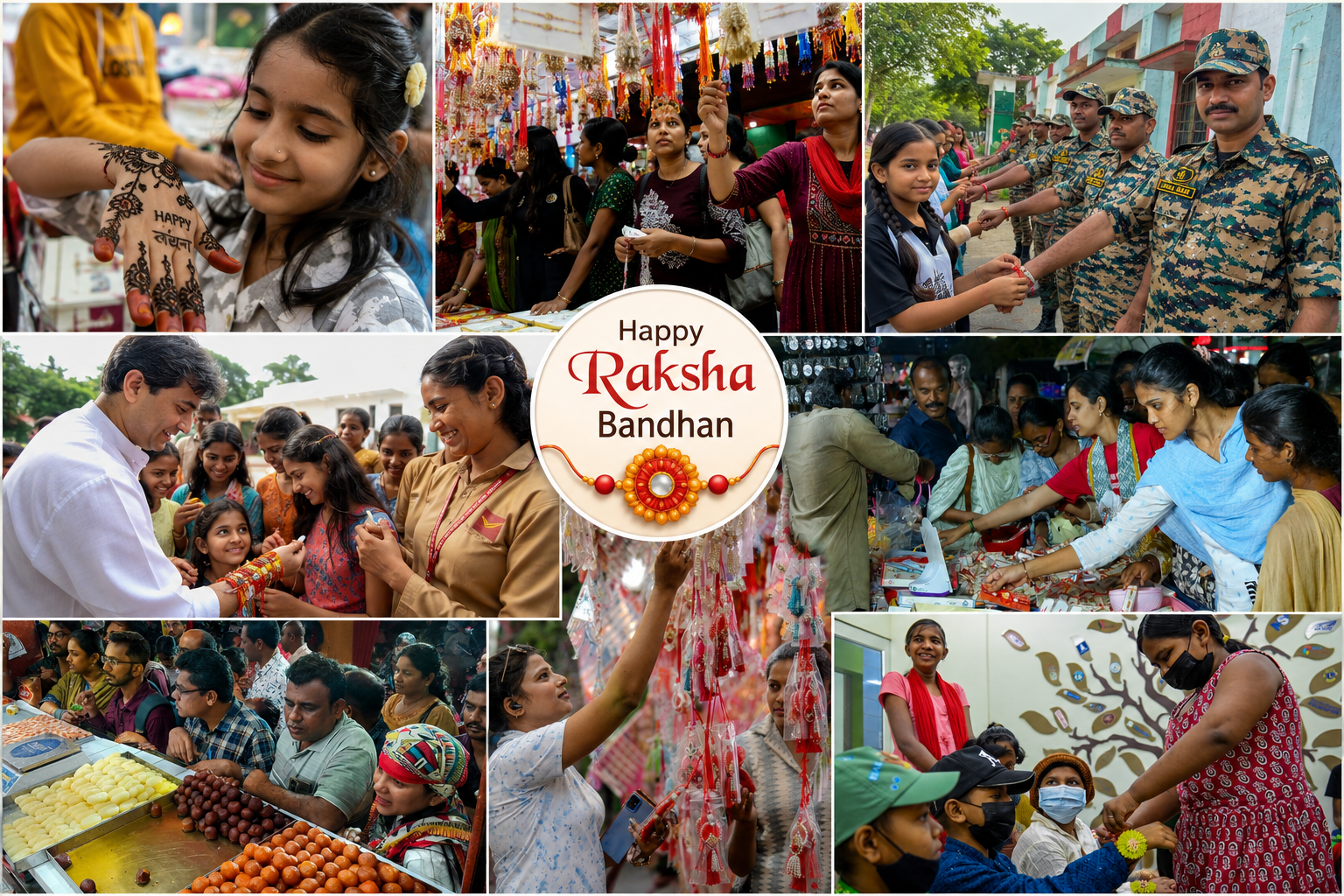
Raksha Bandhan: Celebrating a Bond That Time Cannot Break !
The Rakhi Thread: A Promise of Love, Trust and Togetherness
By Rafat Quadri, Editor BILKULONLINE.COM
Bilkul Online | Festival Special
Ahmedabad | 28 Aug 2026
There are festivals that celebrate a season, a harvest or a victory. And then there is Raksha Bandhan—a festival that celebrates a relationship.
Once a year, a simple thread tied around the wrist becomes a powerful reminder of love, affection, responsibility and an unbreakable family bond. Raksha Bandhan, popularly known as Rakhi, is traditionally celebrated on the full-moon day of the Hindu month of Shravan. On this day, sisters tie a rakhi on their brothers’ wrists and pray for their well-being, while brothers reaffirm their love, support and commitment to stand by their sisters.
But the meaning of Raksha Bandhan has grown far beyond the ritual itself.
More Than Just a Rakhi
The beauty of Raksha Bandhan lies in its simplicity. There is no elaborate ceremony required to express what the heart already knows.
A sister carefully chooses a rakhi. A brother waits for the familiar ritual. There may be sweets, gifts, laughter and photographs. Yet behind these seemingly ordinary moments lies something much deeper—the reassurance that someone will always be there.
The thread itself may be delicate, but the emotion it represents is remarkably strong.
In many families, Raksha Bandhan is also a day of reunion. Brothers and sisters who have moved to different cities or countries make special efforts to come home. For those who cannot travel, a rakhi may arrive by post or courier, while a video call bridges the physical distance. Technology may have changed the way the festival is celebrated, but it has not diminished its emotional significance.
A Tradition With Many Stories
Raksha Bandhan has acquired a rich cultural and historical legacy over the centuries. Different regions and traditions associate the festival with different stories, customs and interpretations.
One of the most widely remembered legends is associated with Krishna and Draupadi, in which Draupadi is said to have tied a piece of cloth around Krishna’s injured finger, and Krishna later promised to protect her. Whether understood literally as history, symbolically as mythology, or simply as a story passed through generations, its underlying message remains powerful: love creates a bond of responsibility.
The festival has also been associated with ideas of social harmony and protection beyond biological relationships. In different periods, the rakhi has symbolised friendship, fraternity and mutual respect.
That broader meaning is particularly relevant today.
The Meaning of ‘Protection’ Is Changing
- The word Raksha means protection, and traditionally the brother has been seen as the protector of the sister. But modern relationships have made this idea much more equal.
- Today, sisters protect brothers too.
- They stand beside each other through career struggles, family responsibilities, personal setbacks and difficult decisions. A sister may be the first person a brother calls when life becomes complicated. A brother may be the person who quietly stands behind his sister when she needs support.
- Protection, therefore, need not mean shielding someone from the world.
- Sometimes it simply means saying:
- “I am with you.”
- That may be the most meaningful promise represented by the rakhi.
From Childhood Fights to Lifelong Friendship
- Perhaps one of the most charming aspects of Raksha Bandhan is that it brings back childhood.
- The brother and sister who once fought over the television remote, argued over chocolates, complained about each other to their parents and competed over the smallest things suddenly find themselves sitting together for the rakhi ceremony.
- Those childhood quarrels become cherished memories with time.
- As people grow older, responsibilities increase. Careers take them to different cities. Marriage changes family structures. Parents grow older. Meetings become less frequent. Yet Raksha Bandhan offers an opportunity to pause and reconnect.
- For a few hours, the pressures of everyday life give way to memories, laughter and family.
The Festival Has Evolved
- Like every living tradition, Raksha Bandhan has evolved.
- Today, rakhis range from traditional cotton threads to handmade, personalised and eco-friendly designs. Families celebrate with everything from homemade sweets to restaurant meals. Brothers and sisters exchange gifts, write personal messages and create memories for social media.
- But beneath these modern expressions remains the same ancient sentiment.
- The festival does not really depend on the price of the rakhi or the gift exchanged.
- A simple thread tied with genuine affection can mean more than an expensive present without emotion.
A Celebration of Siblinghood
- Raksha Bandhan also reminds us that family relationships need nurturing.
- We often assume that people close to us will always remain close. Yet relationships, like anything valuable, require time, attention and affection.
- A phone call, a visit, a shared meal or even a simple message saying “I miss you” can sometimes do more than a grand celebration.
- Raksha Bandhan gives us an annual reminder to make that effort.
- And perhaps that is why the festival continues to remain relevant even in an increasingly modern and individualistic world.
The Thread That Goes Beyond the Wrist
- Ultimately, the rakhi is not merely a thread.
- It is a memory of childhood.
- It is a promise of companionship.
- It is a reminder of family.
- It is an expression of gratitude.
- And it is a quiet assurance that, despite the distances life creates, some relationships remain woven into the fabric of our lives.
- The rakhi may be tied around a wrist, but its real place is in the heart.
This Raksha Bandhan, celebrate not just the ritual of tying a thread, but the beautiful relationship that gives that thread its meaning.
Because years may pass, cities may change and lives may take different paths—but the bond between a brother and sister has a way of bringing them home, again and again.