



Bhupen Hazarika (1926–2011)
- Bilkul Online | Sunday Special
- By Rafat Quadri (Editor)
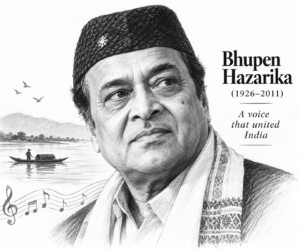

The most interesting way to tell his story is not simply as the biography of a famous singer. It is the story of how a boy from Assam became a cultural bridge between Assam, India and the wider world.
Born in 1926 in Sadiya, Assam, Hazarika showed extraordinary musical ability from a very young age. He recorded his first song when he was still a child. But music was only one part of his intellectual journey.
He studied at Banaras Hindu University, later earned a master’s degree at Columbia University in New York, and came into contact with the ideas of American intellectual Paul Robeson. That experience deeply influenced his understanding of music as a vehicle for social change.
And this is where his story becomes particularly powerful.


He didn’t just sing songs. He told people’s stories.
Hazarika’s songs spoke about ordinary people, poverty, humanity, struggle, rivers, love and social justice.
His most famous Assamese song, “Bistirno Parore”, inspired by the mighty Brahmaputra, became much more than a song about a river. It questioned social inequality and human suffering.
His music subsequently crossed linguistic boundaries. He worked in Assamese, Bengali and Hindi, bringing the emotional world of Northeast India to audiences far beyond Assam.
Then came cinema
Hazarika was also a filmmaker, composer, lyricist, singer and music director.
He worked extensively in Assamese and Bengali cinema, and later became an important presence in Hindi films.
One of his best-known Hindi-film associations was with Rudali, for which his music and songs helped introduce his distinctive musical voice to a national audience.
His greatest achievement?
Perhaps this:
He made regional identity feel like an essential part of Indian identity.
At a time when India’s cultural conversation was often dominated by its larger metropolitan centres, Hazarika brought the voice of Assam and the Northeast into the national consciousness.
He demonstrated that India’s unity did not require everyone to sound the same.
The recognition came late—but spectacularly
Hazarika received the Padma Shri, Padma Bhushan, Padma Vibhushan and, after his death in 2011, India’s highest civilian honour, the Bharat Ratna in 2019.
But awards are almost secondary to his real legacy.
His songs continue to be sung because they contain something much larger than melody: a belief in humanity.
Bhupen Hazarika did not merely sing about India. He gave different Indias a voice—and taught them to hear one another.
(Since 2026 marks his birth centenary year, Bhupen Hazarika’s story is particularly timely for our readers. Hope you liked it)
Note: We seek Sponsors for this column. Please connect with us at infobilkul@gmail.com