



- Bilkul Online | Sunday Special
- By Rafat Quadri (Editor)
Kamala Sohonie (1911–1998)
Kamala Sohonie: The Woman Who Refused to Accept “No”
She challenged a Nobel laureate, worked on a 40-page PhD, studied the humble potato and later turned palm nectar into a weapon against malnutrition.
Kamala Sohonie was born Kamala Bhagvat on 18 June 1911 in Indore. Science was almost a family tradition. Her father, Narayanrao Bhagvat, and uncle, Madhavrao Bhagvat, were chemists and had studied at the Tata Institute of Science in Bangalore, the institution that later became the Indian Institute of Science (IISc).
Kamala Sohonie was born in Indore in 1911 into a family of scientists. In 1933, after standing first in her BSc examination, she applied to the Indian Institute of Science (IISc) in Bangalore.
She was rejected because she was a woman.
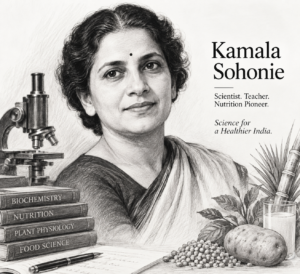

Instead of accepting the decision, Kamala challenged it. IISc was then headed by Nobel laureate C. V. Raman, who eventually admitted her as a probationary researcher under special conditions. She proved herself through her work and went on to complete her MSc with distinction.
Her scientific journey then took her to Cambridge. There, she researched plant respiration and studied cytochrome c, including its presence in potatoes. Remarkably, she completed her doctoral research in about 14 months and received her PhD in 1939.
But Kamala’s most meaningful work came after she returned to India.
She increasingly focused on nutrition and foods important to ordinary Indians, including milk, pulses and legumes. Later, she investigated Neera, the sweet sap obtained from palm trees, after an interest in the subject was encouraged by President Dr Rajendra Prasad.
Her research found that Neera contained valuable nutrients, including vitamins and iron, and explored its potential as an affordable nutritional supplement. Her work earned her the Rashtrapati Award.
Kamala eventually became the first woman to head the Royal Institute of Science in Mumbai.
Her story is remarkable not simply because she broke into a male-dominated scientific world, but because she used advanced science to study something much closer to everyday life: how ordinary Indian food could help improve people’s health.
From a young woman refused admission to a laboratory to a pioneering scientist and institutional leader, Kamala Sohonie’s journey showed that sometimes the most important breakthrough begins with refusing to accept a closed door.
Note: We seek Sponsors for this column. Please connect with us at infobilkul@gmail.com