
The Great Indians – Ratan Tata: Leadership with Heart
- Bilkul Online | Sunday Special
- By Rafat Quadri (Editor)
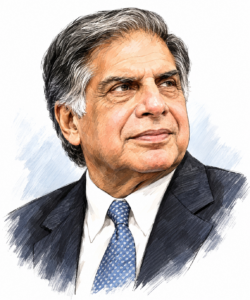
Ratan Tata: The Man Who Built with Vision and Led with Heart
Ratan Tata ( 1937 – 2024)
Some people build businesses. A few build institutions. And a rare few earn a place in the hearts of millions.
India has produced many successful industrialists, but few have inspired the affection that Ratan Naval Tata did. He was a business leader who helped take Indian companies to the world stage, a philanthropist who believed in giving back, and a quiet personality whose influence reached far beyond boardrooms.
What made him remarkable was not simply the size of the Tata Group he led. It was the idea that success should mean something to society.
From the shop floor to the world stage
Born on December 28, 1937, Ratan Tata studied architecture and structural engineering at Cornell University in the United States. He joined the Tata Group in 1962, beginning his career with hands-on experience in its industrial operations before rising to leadership.
In 1991, he succeeded J. R. D. Tata as chairman of Tata Sons, at a time when India was opening its economy to greater competition and global opportunities.
Under his leadership, the Tata Group made major international acquisitions, including Tetley, Corus and Jaguar Land Rover. These moves helped transform the perception of Indian companies: they could do more than compete at home; they could also acquire and manage established global businesses.
One of Ratan Tata’s most memorable ambitions was to make personal mobility more accessible to Indian families.
The idea for the Tata Nano grew from his concern about seeing families travel on two-wheelers in difficult conditions. The result was a small car unveiled in 2008, widely known for its ambitious original price target of ₹1 lakh.
The Nano faced commercial challenges and never achieved the scale originally hoped for. Yet the project revealed something important about its creator: he was willing to attempt something unconventional, even when the outcome was uncertain.
Not every bold idea becomes a commercial success. Sometimes, the ambition behind it tells us just as much about a leader as the final result.
For Ratan Tata, business and social responsibility were never entirely separate worlds.
Through his leadership of the Tata Trusts, he championed a more strategic approach to philanthropy, supporting initiatives in education, healthcare, rural development, livelihoods and technology. The emphasis was not merely on donating money, but on helping create lasting improvements in people’s lives.
This was an important part of his legacy. He represented an approach to wealth in which the question was not only how much can we earn? but also what can we do with what we earn?
His compassion extended to animals, too. His deep affection for dogs inspired the Tata Trusts’ Small Animal Hospital in Mumbai, a specialised facility for animal care. It was a personal interest that became a meaningful public initiative.
In an age when success is often measured by visibility, influence and personal branding, Ratan Tata stood out for his understated manner.
He was not known for the flamboyant public persona associated with some business leaders. Instead, he cultivated an image of restraint, dignity and quiet determination.
He also invested in emerging Indian businesses, backing entrepreneurs and startups at a time when the country’s startup ecosystem was developing rapidly. His interests reflected a willingness to look beyond established industries and consider what the next generation of Indian enterprise might become.
Of course, no business leader’s record is without challenges, and not every initiative succeeds. But his career offers an enduring lesson: leadership requires the courage to make decisions, the patience to build institutions and the humility to recognise that success is never guaranteed.
The legacy that lives on
Ratan Tata passed away on October 9, 2024, at the age of 86. His death prompted tributes from across India and around the world, reflecting the unusual breadth of his influence.
His legacy lives in the companies he helped transform, the institutions he supported, the entrepreneurs he encouraged and the causes he championed.
Perhaps the most important lesson from his life is that a person’s stature cannot be measured by wealth or professional achievements alone. It is also measured by the values they uphold, the opportunities they create for others and the difference they leave behind.
Ratan Tata showed that ambition and humility need not be opposites, and that business success can coexist with a sense of responsibility towards society.
The great Indian Ratan Tata was not merely the man who took Indian businesses to the world. He was a man who reminded India that the true measure of success lies in what we give back.
(Rafat Quadri, Editor BILKUL ONLINE can be reached ateditorbilkul@gmail.com)
Note: We seek Sponsors for this column. Please connect with us at infobilkul@gmail.com