


- Bilkul Online | Sunday Special
- By Rafat Quadri (Editor)
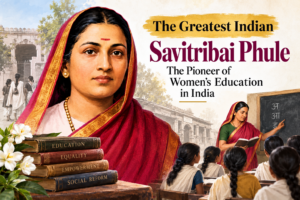

Savitribai Phule — The Woman Who Opened the Doors of Education for Indian Girls
Savitribai Phule — The Woman Who Opened the Doors of Education for Indian Girls
At a time when educating girls was considered unacceptable by many, Savitribai Phule challenged social conventions and helped lay the foundation for a more inclusive India. Her life remains a powerful story of courage, education and equality.
In the history of modern India, some individuals are remembered not because they held positions of power, but because they challenged the very ideas that kept society unequal. Savitribai Phule was one such remarkable figure. A pioneering educator, social reformer and advocate for women’s rights, she devoted her life to making education accessible to girls and communities facing caste-based discrimination.
Born in an era when social customs denied many girls the opportunity to learn, Savitribai dared to imagine a different India—one in which education was not a privilege reserved for a select few, but an opportunity available to everyone. Her journey was difficult, her opposition was fierce, but her determination helped change the course of Indian social history.
A Childhood in Nineteenth-Century India
Savitribai Phule was born on January 3, 1831, in Naigaon, in present-day Maharashtra. She grew up in a society marked by rigid caste hierarchies and deep inequalities between men and women. Formal education was largely inaccessible to girls, particularly those belonging to disadvantaged communities.
Like many girls of her time, Savitribai received little or no formal schooling during her early childhood. Her life took a significant turn after her marriage to Jyotirao Phule, who encouraged her to learn to read and write. With his support, she pursued education and eventually trained to become a teacher.
Education became much more than a personal achievement for Savitribai. She came to see it as a means of challenging injustice, expanding opportunities and enabling people to question social practices that denied them dignity.
The Beginning of a Revolutionary Journey
In 1848, Savitribai and Jyotirao Phule established a school for girls in Bhide Wada, Pune. The school became a landmark in the history of women’s education in India.
At a time when many people opposed girls receiving formal education, opening and running such a school required extraordinary courage. Savitribai took on the role of a teacher when the idea of women teaching girls was itself controversial.
She is widely recognised as one of India’s first modern women teachers. Along with Jyotirao and other associates, including Fatima Sheikh, she helped advance an educational movement that challenged prevailing social restrictions.
The work was not easy. Savitribai faced hostility and harassment from people who believed that educating girls threatened established customs. Historical accounts describe how she was insulted and sometimes had mud or other substances thrown at her while travelling to teach. She reportedly carried an extra sari so that she could change after reaching school and continue her work.
These experiences reveal the personal cost of her commitment. Rather than abandon her mission, she continued teaching, demonstrating that the pursuit of education could be an act of resistance against discrimination.
Education as a Path to Equality
For Savitribai Phule, education was not simply about reading, writing or passing examinations. It was a means of helping people gain independence, self-respect and the ability to challenge injustice.
Her work extended beyond girls’ education. Alongside Jyotirao, she supported educational opportunities for communities oppressed by the caste system. Their efforts challenged the belief that learning should be restricted according to caste, gender or social status.
The Phules understood that social reform required more than isolated acts of charity. It demanded changes in institutions, attitudes and everyday practices. Schools became an important part of their effort to build a society in which people could develop their abilities without being held back by inherited social barriers.
Savitribai’s contribution was particularly significant because girls from disadvantaged backgrounds faced multiple obstacles. Gender discrimination, caste prejudice and poverty could combine to deny them access to education. Her work confronted these barriers at a time when few public institutions were willing to do so.
A Voice for Women and the Marginalised
Savitribai’s reform work extended into several areas of social life. She opposed practices that placed women in vulnerable positions and supported women who faced social exclusion.
Widows, in particular, often experienced severe restrictions and stigma. The Phule couple helped establish a shelter for pregnant widows and sought to protect women who were abandoned or subjected to social rejection. Their efforts reflected a broader commitment to human dignity and the right to live without fear of social punishment.
Savitribai also challenged caste discrimination and the exclusion of marginalised communities from public life. Through the Satyashodhak Samaj, founded by Jyotirao Phule in 1873, the wider reform movement sought to question caste hierarchies and promote social equality. Savitribai played an active role in advancing its ideals.
Savitribai was more than a pioneering teacher; she was a visionary who dared to question an unjust society and work towards a better one. Her legacy reminds us that meaningful social change often begins with a simple but powerful act: giving someone the opportunity to learn.
Her story leaves us with a timeless message: when education reaches those whom society has left behind, it does more than transform individual lives—it helps transform the nation.