Gujarat declares four districts drought-affected, announces crop aid and 150 days of rural employment
Bilkul Online
Gandhinagar
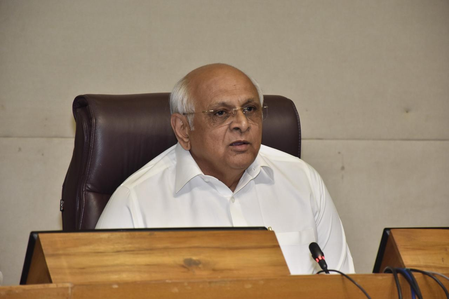
The Gujarat government has declared Devbhumi Dwarka, Porbandar, Kutch and Jamnagar districts drought-affected following deficient and delayed rainfall, announcing crop damage assistance, subsidised fodder and 150 days of employment for rural residents in the affected areas. Chief Minister Bhupendra Patel announced the decision in Gandhinagar in the presence of Agriculture Minister Jitu Vaghani, saying the government had completed the required procedures under the Central government’s Drought Assessment Manual, 2016, and held high-level meetings before declaring the four districts drought-affected. Although Gujarat received around 89 per cent of its average rainfall this year, the four districts recorded lower rainfall, prompting the government to announce relief measures for farmers and livestock breeders. The decisions will come into effect from November 1, 2026.
Under the crop assistance package, farmers affected by crop damage in the four districts will receive Rs 8,500 per hectare under State Disaster Response Fund (SDRF) norms, subject to a maximum limit of two hectares. The government has also decided to provide 150 days of employment under the VB-G RAM G (Viksit Bharat – Guarantee for Rozgar and Ajeevika Mission (Gramin) scheme in the drought-affected talukas to support rural residents. The announcement comes alongside measures to ensure fodder availability and provide financial assistance for livestock maintained at animal camps. Patel said, “The government had anticipated the difficulties arising from delayed rainfall and initiated advance preparations before formally declaring the districts drought-affected.” Fodder distribution at subsidised rates is authorised across Gujarat from June to July 2026, with district collectors specially empowered to facilitate distribution in specific cases. Around 1.21 crore kg of fodder has so far been distributed at Rs two per kg. The state currently has three crore kg of fodder available, and the process of procuring additional stocks has begun. For livestock kept at animal camps in the drought-declared talukas, the government will provide assistance of Rs 80 per animal per day from the SDRF for two months.
“The state government will bear the cost of continuing this assistance thereafter,” the Chief Minister said. Explaining the rationale behind the measures, Patel said the government had consistently prioritised the interests of farmers and livestock breeders under the guidance of Prime Minister Narendra Modi. “The government has stood by farmers during difficult times in the past as well. In the present situation, we stand with them with complete sensitivity and remain fully committed to providing whatever assistance farmers and livestock breeders may need in any future crisis,” he said. The government has also outlined its irrigation plans for the upcoming rabi season, while prioritising drinking water supplies amid concerns over rainfall. During the current kharif season, irrigation water was supplied to the command areas of 44 dams based on demand. The state’s 206 major dams currently have water storage at 66 per cent of their capacity, according to the government.
For the rabi season, irrigation water supply has been planned for the command areas of 76 dams. Drinking water has been given priority, with supplies reserved for this purpose until June 30, 2027. The irrigation plan covers 11 dams, including Dharoi and Dantiwada, in North Gujarat; 12 dams, including Karjan and Panam, in Central Gujarat; and nine dams, including Ukai, Kakrapar and Damanganga, in South Gujarat. Irrigation has also been planned for 39 dams, including Shetrunji, Brahmani and Machhu, and five dams in the Kutch region. Depending on water availability, the government plans to provide between one and four irrigation cycles from the identified dams during the rabi season.