NID Ahmedabad Hosts Two-Day ‘Drawing Dialogues 2026’ Symposium at Gandhinagar Campus
Bilkul Online
Two-Day NID Symposium Highlights the Evolving Role of Drawing in Design Practice
Bilkul Online
Ahmedabad | 02 Nov 2026
The National Institute of Design (NID), Ahmedabad, organised a two-day symposium, Drawing Dialogues 2026: Calibration and Celebration of Drawing in Design, on October 30 and 31 at its Gandhinagar campus. The event brought together educators, designers, researchers and students to explore the evolving role of drawing in design education and professional practice.
The symposium was inaugurated in the presence of Chief Guest Dr Sachchidanand Joshi, Member Secretary of the Indira Gandhi National Centre for the Arts (IGNCA). Prof. Kaushik Chakraborty, Senior Faculty of Communication Design and Animation Film Design, led the symposium.
Centred on the Indian philosophical concepts of Drishti (seeing) and Anubhava (experience), the symposium examined drawing as more than a representational skill, highlighting its importance in observation, imagination, reflection, communication and creative inquiry.
Addressing the gathering, NID Director Dr Ashok Mondal emphasised that drawing remains central to the institute’s philosophy of design education. He noted that drawing helps develop observation, critical thinking, sensitivity and imagination, particularly in an era increasingly influenced by digital technologies and artificial intelligence. Referring to Rabindranath Tagore’s creative expression, he highlighted the ability of drawing to communicate thoughts and emotions beyond words.
Dr Mondal also reaffirmed NID’s commitment to strengthening academic collaborations with institutions and individuals in India and abroad through joint research, faculty and student exchanges, workshops, exhibitions and publications.
Prof. Vijai Singh Katiyar, Chairperson, Education, described drawing as the fundamental language of design, enabling designers to observe details, explore possibilities and communicate ideas. Recalling NID’s Drawing-by-Design initiative of 2015, which featured over 32 multidisciplinary international open elective workshops, he highlighted the need to preserve drawing and making as essential elements of design pedagogy. He observed that students increasingly move away from drawing practices after their foundation programme, often relying more on technological tools, and stressed the importance of developing foundational hand skills alongside digital capabilities.
The symposium featured discussions across five key themes: Pedagogy of Drawing in Design Education, Drawing Research, Traditions of Drawing, Drawing Practice: Case Studies and Industry Experience, and Drawing Futures.
The first-of-its-kind symposium at NID, and a relatively rare initiative at the national level, received nearly 150 paper submissions, of which 27 were selected for presentation, including six from international participants.
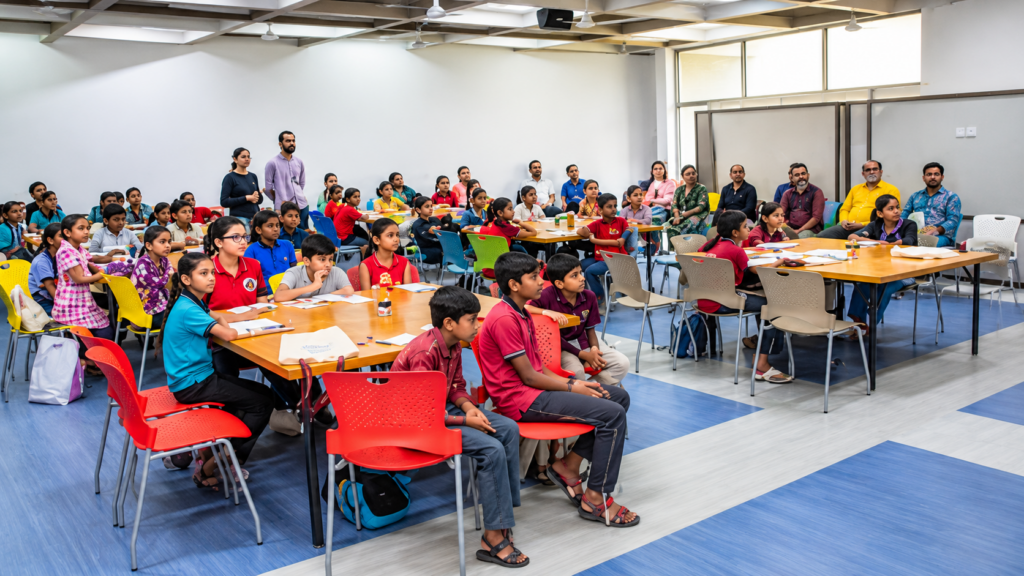
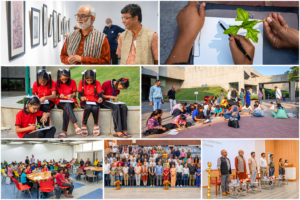
As part of its outreach initiative, NID also organised a specially designed interactive drawing workshop for over 40 primary school students from various Gandhinagar municipal schools. The session aimed to encourage creativity, self-expression and artistic skills through hands-on guidance from design educators.
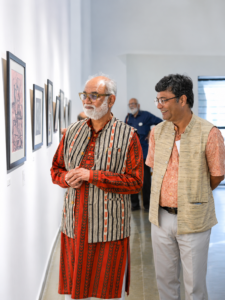
The event also featured Visions in Line: A Celebration of Drawings, an exhibition exploring drawing as a medium of visual thinking, expression and creative inquiry. Divided into three sections—Communication, Documentation and Visualisation—the exhibition showcased how drawing contributes to observation, knowledge creation, documentation and the communication of ideas across creative disciplines.
In his address, Dr Sachchidanand Joshi highlighted drawing’s significance in understanding India’s civilisational heritage. Referring to prehistoric drawings and the undeciphered Saraswati-Sindhu script, he explained how visual expression transcends linguistic barriers and transforms abstract thoughts into tangible forms. He also cautioned against excessive dependence on artificial intelligence and digital technologies, stressing that drawing nurtures human creativity, imagination and emotional connections. Drawing parallels with music, he emphasised the importance of riyaz and sadhana—dedicated and sustained practice—in developing visual sensitivity and creative expression.
The symposium concluded with an emphasis on sustaining drawing as an essential part of design education, research and creative practice, while encouraging continued academic and creative exchanges.