


New Delhi
Residents of Delhi and the surrounding areas woke up to ‘very poor’ air quality on Diwali morning as the national capital recorded an overall Air Quality Index (AQI) of 384, indicating a concerning pollution situation across the city.
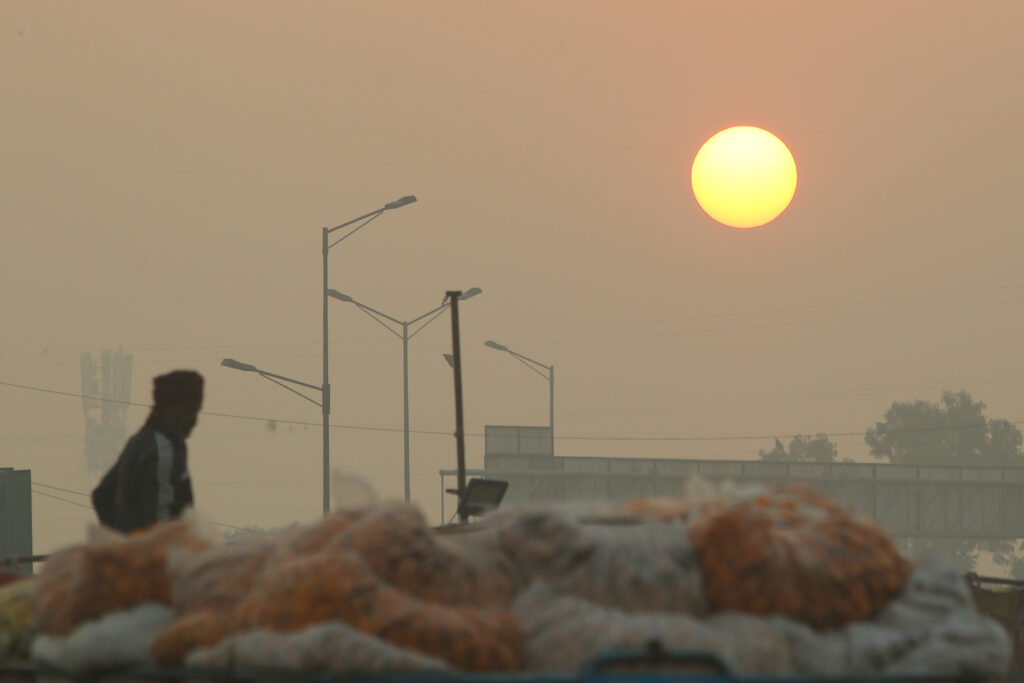
A view of the sun shining through the dense smog near the Anand Vihar area in New Delhi on Saturday, November 7, 2026. (Photo: IANS/Prem Nath Pandey)
New Delhi
Residents of Delhi and the surrounding areas woke up to ‘very poor’ air quality on Diwali morning as the national capital recorded an overall Air Quality Index (AQI) of 384, indicating a concerning pollution situation across the city.
According to data by the Central Pollution Control Board (CPCB), air pollution levels remained particularly alarming in several parts of Delhi, where 11 monitoring stations registered AQI readings above 400, placing them in the ‘severe’ category. Punjabi Bagh recorded the highest AQI at 450, followed by RK Puram at 449 and IIT Delhi at 446. Dwarka also reported a high reading of 444, while CRRI Mathura Road registered an AQI of 425 and Siri Fort recorded 423. According to the 6 a.m. update, out of the 23 monitoring stations listed, 11 recorded AQI levels exceeding 400, indicating severe air pollution.
The remaining 12 stations reported readings ranging between 301 and 400, placing them in the ‘very poor’ category. Chandni Chowk recorded an AQI of 423, Pusa reported a reading of 415, North Campus of Delhi University recorded 423, while Burari Crossing registered 411 and NSUT Jaffarpur recorded 409. Among other locations, Narela recorded an AQI of 399, followed by ITO at 396 and Mandir Marg at 393.
Talkatora Garden and Aya Nagar both registered readings of 369, while Burari recorded an AQI of 370. Uttam Nagar also reported poor air quality, with its AQI standing at 373. Anand Vihar recorded an AQI of 328, remaining in the ‘very poor’ category despite registering a comparatively lower reading than several other parts of the capital. Meanwhile, Vasundhara Enclave reported an AQI of 356, while Tikri Kalan and Badarpur both recorded readings of 349. Karala registered an AQI of 337, whereas Lodhi Road reported a reading of 333, according to the morning pollution data.