
Why Is It So! Why Do Petrol Prices Rise Even When Crude Oil Prices Fall?
Bilkul Online | Weekly Special Curiosity Column
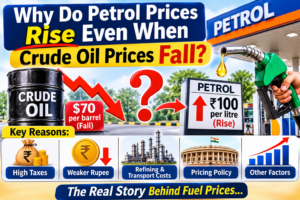
Why Do Petrol Prices Rise Even When Crude Oil Prices Fall?
Have you ever wondered why petrol prices at your local fuel station do not always come down when international crude oil prices fall? It seems logical that cheaper crude oil should mean cheaper petrol. However, the reality is quite different.
The reason lies in the way petrol prices are calculated, particularly in countries like India.
- Crude Oil Is Only One Part of the Price
Crude oil is the primary raw material used to produce petrol and diesel. However, the price consumers pay at fuel stations includes several other components, such as refining costs, transportation, dealer commissions and government taxes.
Therefore, even when crude oil becomes cheaper, the final retail price may not fall proportionately.
- Government Taxes Make a Big Difference
In India, petrol prices include central excise duty and state-level VAT (Value Added Tax). These taxes form a significant part of the price paid by consumers.
Even if international crude oil prices decline, these taxes may remain unchanged. As a result, the benefit of cheaper crude oil may not fully reach consumers.
- A Weaker Rupee Can Cancel Out Cheaper Oil
India imports a large portion of its crude oil requirements and pays for these imports in US dollars.
Imagine international crude oil prices fall, but the Indian rupee weakens against the US dollar. Importing the same quantity of oil could then become more expensive in rupee terms.
For example, a fall in crude oil prices from $80 to $70 per barrel may not translate into equivalent savings if the rupee depreciates significantly during the same period.
- Refining and Transportation Costs Matter
Crude oil cannot be used directly as petrol. It must first be refined into usable fuels and then transported through pipelines, tankers and other distribution networks.
Changes in refining margins, transportation expenses and operating costs can also influence the final price.
- Why Don’t Fuel Prices Change Every Day?
Although international crude oil prices fluctuate regularly, retail petrol and diesel prices in India are generally revised by oil marketing companies based on their pricing decisions and market conditions.
Companies may not immediately pass on every international price movement to consumers. Timing, inventory costs, exchange rates and other commercial considerations can influence when and how prices are revised.
So, Who Benefits When Crude Oil Prices Fall?
When crude oil becomes cheaper, oil marketing companies may benefit from lower input costs. Depending on government tax policies and pricing decisions, the savings may also help government finances or eventually translate into lower fuel prices for consumers.
However, consumers do not automatically receive the full benefit.
The Bottom Line
Petrol prices are influenced by much more than the international price of crude oil. Taxes, currency exchange rates, refining costs, transportation expenses and oil companies’ pricing decisions all play a role.
So, the next time you hear that crude oil prices have fallen but petrol remains expensive, remember: cheaper crude oil does not necessarily mean cheaper petrol at the pump!
WHY IS IT SO? — Exploring the Science behind everyday mysteries, only on BilkulOnline.
Note: Note: You can support us by sponsoring this column. Write at infobilkul@gmail.com Thank You