


- Bilkul Online | Sunday Special
- By Rafat Quadri (Editor)
Pandit Jawaharlal Nehru: The Architect of Modern India and a Visionary Who Dreamed of a New Nation
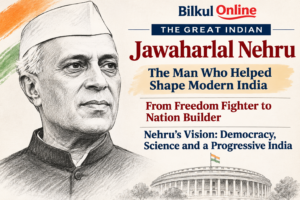

Pandit Jawaharlal Nehru: The Architect of Modern India and a Visionary Who Dreamed of a New Nation
From the struggle for independence to shaping the destiny of a newly born nation, Jawaharlal Nehru’s life was defined by his belief in democracy, scientific progress, secularism and the power of education.
India’s journey as an independent nation began in August 1947, amid enormous challenges, uncertainty and the expectations of millions. At the helm of this historic transition stood Pandit Jawaharlal Nehru, India’s first Prime Minister, whose vision, leadership and political philosophy played a defining role in shaping the country’s early years.
A freedom fighter, intellectual, writer, statesman and modernist, Nehru was among the most influential personalities of India’s 20th-century history. His contribution extended beyond the freedom movement. He helped lay the foundations of India’s democratic institutions, scientific establishments, educational framework and international identity.
Born on November 14, 1889, in Allahabad (now Prayagraj), Uttar Pradesh, Jawaharlal Nehru belonged to an affluent and influential family. His father, Motilal Nehru, was a distinguished lawyer and an important leader of the Indian National Congress. Growing up in a privileged environment, Nehru received his early education at home before travelling to England for higher studies.
He studied at Harrow School and later attended Trinity College, Cambridge, where he pursued natural sciences. He subsequently studied law at the Inner Temple in London. However, the political atmosphere of India and the growing demand for freedom gradually drew him away from a conventional professional life towards the national movement.
From a Young Barrister to a Freedom Fighter
After returning to India in 1912, Nehru initially practised law but soon became increasingly involved in politics. His association with Mahatma Gandhi, whom he met in 1916, proved particularly significant.
Gandhi’s philosophy of non-violence and mass mobilisation deeply influenced Nehru. He became an active participant in the freedom struggle and emerged as one of the prominent younger leaders of the Congress.
Nehru participated in several movements against British rule, including the Non-Cooperation Movement and the Civil Disobedience Movement. His commitment to India’s independence came at a personal cost, as he was arrested and imprisoned several times by the British authorities.
His political thinking also evolved during these years. Nehru strongly supported complete independence rather than limited constitutional reforms. At the Lahore Session of the Indian National Congress in December 1929, under his presidency, the Congress formally adopted the goal of Purna Swaraj, or complete independence. The declaration marked a decisive moment in India’s freedom struggle.
Nehru’s international outlook also distinguished him from many contemporary leaders. He believed India’s freedom was connected to the larger global struggle against colonialism, imperialism and racial discrimination.
The First Prime Minister of Independent India
On August 15, 1947, India became independent, and Jawaharlal Nehru assumed office as the country’s first Prime Minister.
The responsibilities before him were immense. Partition had caused widespread violence, displacement and communal tensions. Millions of people were struggling to rebuild their lives, while the newly independent country faced poverty, illiteracy, economic backwardness and the challenge of integrating princely states.
Nehru believed that political independence would have little meaning unless it was accompanied by social and economic transformation.
He championed parliamentary democracy, constitutional governance, freedom of expression and secularism. At a time when several newly independent countries were experiencing political instability or authoritarian rule, India continued its democratic journey through regular elections and functioning parliamentary institutions.
His belief in a pluralistic India was central to his political philosophy. He envisioned a country where people of different religions, languages, cultures and communities could live together with equal dignity and constitutional rights.
Building the Foundations of Modern India
One of Nehru’s most significant contributions was his emphasis on building institutions that could support India’s long-term development.
He believed that science, technology, industrialisation and education were essential for transforming a poor and largely agrarian country into a modern nation.
Under his leadership, India adopted planned economic development through successive Five-Year Plans. The government invested heavily in heavy industries, steel plants, power generation, dams and infrastructure.
Major public-sector industrial projects were established, while institutions such as the Indian Institutes of Technology (IITs) were developed to strengthen technical education.
Nehru also supported the expansion of scientific research. The foundations of institutions such as the Department of Atomic Energy, established in 1954, and the development of India’s space and nuclear research capabilities reflected his commitment to scientific advancement.
He famously described large dams as the “temples of modern India”, reflecting his belief that infrastructure and industrial development could improve the lives of ordinary citizens.
His government also strengthened higher education and medical research, supporting institutions that would eventually become important centres of national excellence.
A Voice for Peace and Non-Alignment
Nehru’s influence was not restricted to domestic politics. He played an important role in shaping India’s foreign policy during the Cold War.
At a time when the world was divided between the American-led Western bloc and the Soviet-led communist bloc, Nehru advocated an independent foreign policy.
Along with leaders such as Yugoslavia’s Josip Broz Tito, Egypt’s Gamal Abdel Nasser, Indonesia’s Sukarno and Ghana’s Kwame Nkrumah, he became one of the leading figures associated with the Non-Aligned Movement.
The movement sought to provide newly independent countries with an alternative to military and political alignment with major power blocs.
Nehru consistently advocated peaceful coexistence, international cooperation, disarmament and the resolution of disputes through dialogue.
His foreign policy, however, faced a major setback in 1962 when China launched a military offensive against India. The Sino-Indian War exposed serious weaknesses in India’s defence preparedness and dealt a significant blow to Nehru’s international standing and political confidence.
The conflict remains one of the most criticised chapters of his premiership.
The Writer, Thinker and Humanist
Beyond politics, Nehru was a prolific writer whose works reflected his intellectual curiosity and understanding of history.
His books, including The Discovery of India, Glimpses of World History and An Autobiography, remain important literary contributions. Written during periods of imprisonment, these works reveal his thoughts on civilisation, culture, freedom, science and humanity.
The Discovery of India, written during his imprisonment at Ahmednagar Fort between 1942 and 1945, explores India’s historical and cultural journey and expresses his belief in the country’s remarkable diversity and civilisational continuity.
Nehru also had a special affection for children. His birthday, November 14, is celebrated across India as Children’s Day. Popularly remembered as ‘Chacha Nehru’, he believed that
children represented the future of the nation and deserved opportunities for education, care and development.
Nehru’s legacy is vast, but it is not without controversy. His economic model, with its emphasis on state-led planning and a large public sector, has been debated for decades. Critics have questioned the pace of economic growth during his premiership, his handling of the Kashmir issue, his approach towards China and the country’s military preparedness before the 1962 war.
Nevertheless, his supporters point to the democratic foundations, scientific institutions, educational infrastructure and international stature that India developed during his tenure.
He served as Prime Minister for nearly 17 years, becoming one of the longest-serving leaders in independent India’s history.
On May 27, 1964, Jawaharlal Nehru passed away in New Delhi at the age of 74. His death marked the end of an important chapter in India’s political history.
Jawaharlal Nehru was a leader of extraordinary influence whose life was closely intertwined with India’s transition from colonial rule to independence. He inherited a nation facing enormous challenges and attempted to shape it through democratic values, institutional development, scientific temper and a vision of social progress.
History will continue to examine and debate his decisions, achievements and shortcomings. Yet, his role in establishing the foundations of India’s parliamentary democracy and modern institutions remains an important part of the country’s story.
His greatest contribution may lie in the idea that India could be modern without abandoning its diversity, democratic without surrendering its freedom, and progressive without losing its cultural identity.
For a nation emerging from centuries of colonial rule, that was an ambitious dream. And Jawaharlal Nehru was among the leaders who gave that dream its earliest direction.
Note: We seek Sponsors for this column. Please connect with us at infobilkul@gmail.com
