


- Bilkul Online | Weekly Special Curiosity Column
- 22 Nov 2026 | Sunday Special
Why Does the Sky Turn Orange and Red at Sunset? The Science Behind Nature’s Colourful Show
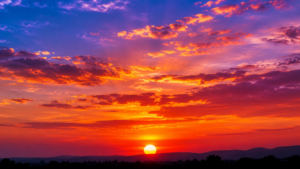

Why Does the Sky Turn Orange and Red at Sunset? The Science Behind Nature’s Colourful Show
Have you ever stopped to admire a beautiful sunset and wondered why the sky changes from bright blue to shades of orange, red, pink and purple? It is one of nature’s most fascinating daily spectacles, but behind this colourful display lies an interesting scientific explanation.
The secret is hidden in sunlight and the Earth’s atmosphere.
Sunlight Is Made Up of Many Colours
Although sunlight appears white to our eyes, it is actually made up of different colours, including violet, blue, green, yellow, orange and red. Each colour has a different wavelength.
When sunlight enters the Earth’s atmosphere, tiny molecules of air scatter the shorter wavelengths, particularly blue light, more strongly than the longer wavelengths. This phenomenon is known as Rayleigh scattering. That is why the sky generally appears blue during the day.
What Changes During Sunset?
At sunset, the Sun is close to the horizon. Its light has to travel through a much longer stretch of the atmosphere before reaching our eyes.
During this longer journey, much of the blue and violet light gets scattered away from the direct path of sunlight. The remaining direct light becomes richer in longer wavelengths, such as orange and red.
As a result, the sky near the setting Sun often displays beautiful shades of orange, red and yellow.
Why Are Some Sunsets More Colourful Than Others?
Not every sunset looks the same. The colours can change depending on atmospheric conditions.
Dust particles, smoke, tiny water droplets and other aerosols can influence how sunlight is scattered. Clouds can also reflect and display the warm colours of the setting Sun, creating spectacular patterns across the sky.
Sometimes the sky turns pink or purple because different colours of sunlight interact with clouds and atmospheric particles.
Does Pollution Make Sunsets More Beautiful?
Interestingly, particles in the atmosphere can sometimes produce more dramatic sunset colours. However, that does not mean pollution is good. Air pollution is harmful to human health and the environment, even if it occasionally creates striking visual effects.
A Daily Scientific Wonder
The next time you watch the Sun disappear beyond the horizon, remember that you are witnessing more than a beautiful natural scene. You are seeing sunlight interact with the Earth’s atmosphere in a fascinating scientific process.
Nature’s colourful evening display is a reminder that even the simplest everyday sights can have extraordinary explanations.
WHY IS IT SO? — Because science is happening all around us, even when we are simply watching the sunset!
