RRU’s SAMUNDRARAKSHAN 2.0 Showcases India’s Advancing Maritime Preparedness
Maritime Simulator Launch Marks Highlight of SAMUNDRARAKSHAN 2.0 at RRU
SAMUNDRARAKSHAN 2.0 Concludes at RRU, Reinforces India’s Coastal and Maritime Security Vision
Bilkul Online
Gandhinagar | December 4, 2025
The School of Integrated Coastal and Maritime Security Studies (SICMSS) at Rashtriya Raksha University (RRU) successfully concluded the second edition of its flagship coastal security programme, SAMUNDRARAKSHAN 2.0, on the occasion of Indian Navy Day. Held at the RRU campus in Lavad–Dahegam, the conclave served as a vital platform to strengthen India’s maritime security architecture under the evolving vision from SAGAR to MAHASAGAR—Mutual and Holistic Advancement for Security and Growth Across Regions.
A Convergence of Key Maritime Stakeholders
SAMUNDRARAKSHAN 2.0 brought together a wide spectrum of participants, including policymakers, security professionals, researchers, and maritime practitioners. Discussions centred on enhancing inter-agency coordination, adopting advanced technologies, and increasing community participation to secure India’s extensive coastline and maritime interests.
The event saw participation from 200+ officers representing Marine Police units from 13 coastal states and union territories, the Indian Navy, Indian Coast Guard, CISF, BSF, port authorities, maritime boards, industry experts, and maritime start-ups—underscoring RRU’s growing role in raising maritime consciousness nationally and globally.
Unveiling of India’s State-of-the-Art Maritime Simulator Lab
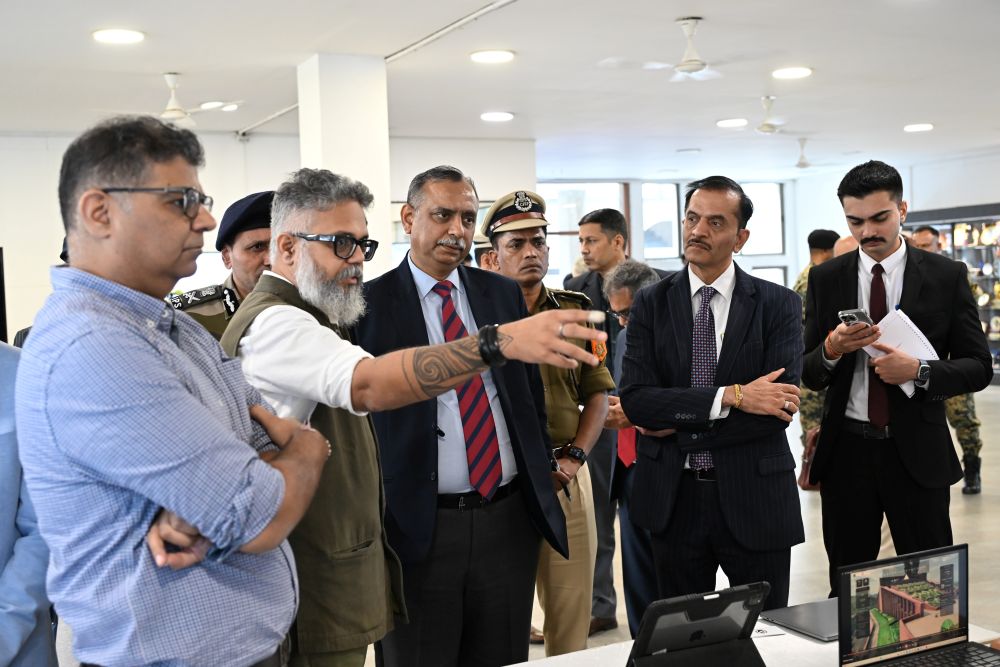
A highlight of this year’s edition was the unveiling of India’s advanced Maritime Simulator Lab, designed to offer hands-on training for critical operations including interdiction, hot pursuits, law enforcement, navigation, search and rescue, and marine pollution response.
The facility will serve the Indian Maritime Forces, maritime law professionals, and officials from partner nations under the MEA’s ITEC programme, reaffirming India’s commitment to world-class maritime capacity building.

Strategic Insights from National Leadership
Vice Admiral Biswajit Dasgupta (Retd.), National Maritime Security Coordinator
Delivering a virtual address, he emphasised the growing importance of SAMUNDRARAKSHAN as a shared platform for collaborative learning. He highlighted India’s “Blue Acceleration” over the past 25 years and cautioned about emerging vulnerabilities, including radical ideologies emanating from neighbouring regions. He noted the major value addition the Simulator Lab brings to maritime training in India.
Praveer Ranjan, Director General, CISF
He stressed the need for a multi-stakeholder approach to coastal security and expressed confidence in CISF’s ability to replicate its aviation security success in port security. He cited key reforms—CISF’s designation as RSO, amendments to shipping laws, hybrid port-security models, and EXIM port audits—as major steps in strengthening India’s maritime security framework. He called for greater infusion of technologies such as AI and Aadhaar-based systems.

Prof. (Dr.) Bimal N. Patel, Vice-Chancellor, RRU
Prof. Patel expressed deep satisfaction with the programme’s success and reiterated RRU’s commitment to pioneering training, research, and capacity building in maritime security.
He emphasised India’s emergence as a “steady lighthouse in rough global seas”, referencing the Prime Minister’s vision at Indian Maritime Week 2025. Highlighting reforms replacing colonial-era shipping laws, the ₹70,000-crore maritime initiatives, and the School’s 70+ programmes with 125 global experts, he welcomed the MoU with CISF as a significant step toward strengthening coastal security.
Ashwini Kumar Singh, DIG, National Academy of Coastal Policing (NACP)
He underlined the distinct challenges of coastal policing compared to land borders and highlighted NACP’s progress—training 1,600+ personnel and developing a world-class 250-acre campus on the Dwarka–Okha Road. With marine police foundation courses, a full-fledged water wing, and specialised technical schools, he noted that SAMUNDRARAKSHAN 2.0 strengthens India’s maritime safety architecture, with RRU as a valued partner.
Focus Areas of the Conclave
This edition emphasised:
- Integration of cutting-edge technologies in maritime border surveillance
- Climate change and rising sea levels as emerging security threats
- Countering drug trafficking along India’s coastline and ports
- Strengthening coordination among maritime forces through joint exercises
- Improving transparency and security via port audits and hybrid security models
SAMUNDRARAKSHAN 2.0 concluded with a renewed commitment to collaborative, technology-enabled, and future-ready coastal and maritime security—reflecting India’s growing leadership in the Indo-Pacific’s security landscape.
kindly Like the shared links and Subscribe our channel for such valuable updates. https://youtube.com/shorts/Djv9sip29ag?feature=share