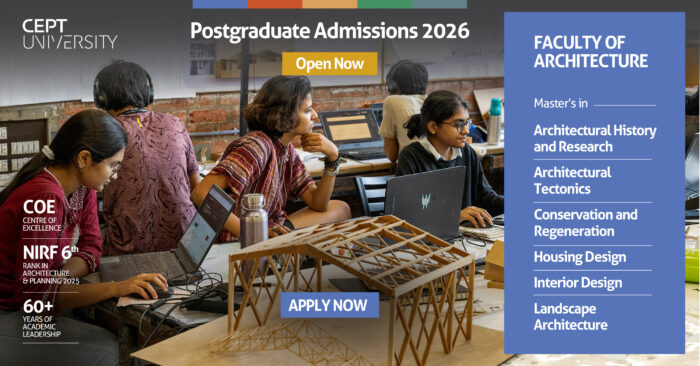
CEPT University Opens Admissions for Architecture Postgraduate Programs; Applications Open Until March 31, 2026
- Bilkul Online
- Ahmedabad | 05 March2026
With the growing challenges posed by climate change, rapid urbanisation, and evolving technologies, architecture today demands greater responsibility, innovation, and technical precision. Responding to these changing demands, CEPT University has announced the opening of applications for its postgraduate programs offered by the Faculty of Architecture for the 2026 academic cycle. Registrations will remain open until March 31, 2026.
The postgraduate programs at CEPT are designed to go beyond conventional academic learning by encouraging specialised exploration and critical engagement with real-world challenges. At the Faculty of Architecture, studio-based learning acts as a laboratory for experimentation where small groups of students work closely with expert tutors to develop ideas, test prototypes, and refine their design positions through rigorous critique.
The curriculum is spread across regular semesters as well as summer and winter schools, enabling students to explore diverse aspects of the built environment. Learners also gain access to CEPT’s extensive resources including workshops, software facilities, archives, material laboratories, and a vast network of national and international professionals.
Highlighting the vision behind the programs, Sameep Padora, Dean of the Faculty of Architecture at CEPT University, said that postgraduate architectural education must move beyond skill-building to nurture clarity of thought, technical depth, and the confidence to take informed design positions. According to him, the studios at CEPT are structured as spaces for deep inquiry where students confront real-world constraints, test ideas through materials and context, and develop an independent architectural voice capable of addressing complex issues such as climate change, culture, construction, and technology.
The Faculty of Architecture currently offers six specialised postgraduate programs, each addressing a critical dimension of the built environment.
The Master’s in Landscape Architecture (MLA) program focuses on ecological systems and climate-responsive design. The course prepares students to work across multiple scales—from regional watersheds to urban public spaces—while addressing environmental and social challenges. Graduates become part of a global alumni network of more than 500 professionals working in practice, research, and academia.
The Master’s in Interior Design (MID) program combines interdisciplinary learning with hands-on studio practice. Students gain exposure to emerging technologies and industry practices while benefiting from international exchange opportunities and strong industry collaborations, enabling career opportunities in leading design firms and consultancies worldwide.
The Master’s in Architecture (Housing Design) program addresses India’s urgent need for socially responsive and environmentally responsible housing. The fully choice-based curriculum allows students to tailor their academic pathway while engaging with both speculative design explorations and real-world housing challenges.
The Master’s in Conservation and Regeneration (MCR) program approaches conservation as an ecological and design-led process. The program prepares professionals to creatively reinterpret historic structures while addressing contemporary developmental pressures. It is particularly relevant as investments in the revitalisation of historic environments increase across India.
The Master of Architectural Tectonics (MAT) program explores the intersection of architecture and technology. It focuses on the relationship between construction detailing, materials, and architectural expression. Through drawing, computation, prototyping, and material experimentation, students learn how structural clarity and material intelligence shape architectural ideas.
The Master’s in Architectural History and Research (MAHR) program develops critical and historical thinking about the built environment. Through research, archival studies, drawing, and writing, students gain analytical skills that prepare them for careers in research, conservation, publishing, policy, education, and architectural practice.
Interested applicants can find detailed information about eligibility criteria, scholarships, and application procedures on the official CEPT University website. The university encourages graduates seeking deeper intellectual engagement with architecture and the built environment to apply.
CEPT University is widely recognised as a leading institution in education and research related to architecture, planning, design, technology, and urban management. Established in 1962 as the School of Architecture and formalised through the CEPT University Act of 2005 by the Government of Gujarat, the institution today comprises five faculties: Architecture, Planning, Technology, Design, and Management.
In December 2023, the Government of India recognised CEPT University as a Centre of Excellence in Urban Planning and Design and granted an endowment of ₹250 crore to support research and training in India-specific urban planning and design knowledge over the next 25 years. The university also holds recognition as a Scientific and Industrial Research Organisation (SIRO) from the Department of Scientific and Industrial Research and maintains over 30 international academic collaborations.