
The Great Indians – Sir Syed Ahmad Khan
Sir Syed Ahmad Khan: The Visionary Who Made Education a Mission
- Bilkul Online | Sunday Special
- By Rafat Quadri (Editor)
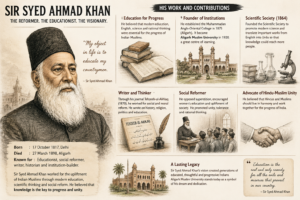
Born: 17 October 1817, Delhi
Died: 27 March 1898, Aligarh
Known for: Educationist, social reformer, writer, historian and founder of the Aligarh Movement
A Child of Old Delhi
Sir Syed Ahmad Khan was born in Delhi in 1817 into a respected Muslim family with close connections to the Mughal court. He grew up at a time when the Mughal Empire was rapidly losing power and the British East India Company was becoming the dominant force in India.
His formal education included the Quran, Persian, Arabic and traditional subjects. But he also developed an unusually curious and questioning mind.
In 1838, he joined the East India Company’s judicial service and spent several decades working in different parts of North India. His experience as a government official gave him a close look at Indian society—and particularly at the difficulties faced by Muslims as the old order disappeared.
1857 Changed His Life
The Revolt of 1857 was the great turning point in Sir Syed’s life.
While serving as a judicial officer at Bijnor, he witnessed the upheaval and its aftermath. He subsequently wrote Asbab-e-Baghawat-e-Hind (The Causes of the Indian Revolt), in which he argued that the British administration itself had contributed to the uprising through its policies and its failure to understand Indian opinion.
The experience convinced him that confrontation alone would not help his community.
He came to believe that education—particularly modern education, English and science—was the key to social and economic advancement.
The official history of Aligarh Muslim University describes 1857 as one of the decisive turning points in his life.
His Revolutionary Idea: Modern Education
At a time when sections of traditional Muslim society were suspicious of Western education, Sir Syed took a bold position.
He argued that Muslims should learn English, mathematics, modern sciences and Western thought while retaining their cultural and religious identity.
His philosophy was essentially: do not fear modern knowledge—use it to strengthen society.
He began establishing educational institutions, including a school at Moradabad in 1858 and another at Ghazipur in 1863.
He also founded the Scientific Society, initially at Ghazipur, to translate important Western works into Indian languages and encourage scientific thinking.
This was remarkable for its time. Sir Syed was not merely asking people to study; he wanted them to change the way they thought.
The Aligarh Movement
His greatest achievement was the movement that eventually became known as the Aligarh Movement.
In 1875, he established the educational institution that developed into the Muhammadan Anglo-Oriental College. The college was formally founded in 1877 and was modelled partly on the residential educational system of Oxford and Cambridge, which Sir Syed had seen during his visit to England.
His dream was much bigger than building a college.
He wanted to create a new generation of educated Indians—especially Muslims—who could enter government, professions, science and public life.
The institution eventually became Aligarh Muslim University in 1920, more than two decades after his death.
He Was Also a Social Reformer
Sir Syed understood that education alone was not enough. Society itself needed reform.
In 1870 he launched Tehzeeb-ul-Akhlaq, a journal devoted to social and moral reform. Through his writings, he challenged superstition, outdated social practices and resistance to modern education.
He argued for rational thinking and encouraged Muslims to engage with science and contemporary knowledge.
His reformist ideas were controversial. Some conservative religious scholars strongly opposed him, while some admirers regarded him as one of the first major Muslim modernists of the subcontinent.
His Relationship With the British
This is one of the most debated aspects of his life.
After 1857, Sir Syed believed that Muslims needed to rebuild their position through education and cooperation with the British rather than another armed confrontation.
He therefore adopted a relatively loyalist political position towards the British government.
This does not mean he blindly supported everything the British did. His writings on the causes of the 1857 revolt criticised British administrative failures. But he increasingly believed that confrontation would harm the already educationally and economically disadvantaged Muslim population.
His priority was clear: educate first, strengthen society and then participate effectively in public life.
Sir Syed and the Indian National Congress
Sir Syed’s political thinking later brought him into disagreement with the newly formed Indian National Congress, established in 1885.
He feared that representative politics based simply on numbers could leave Muslims politically disadvantaged in areas where they were a minority. He therefore advised Muslims to concentrate on education and to be cautious about joining Congress politics.
In 1888, he was associated with the United Indian Patriotic Association, which sought cooperation between Indian interests and the colonial government.
This remains one of the most controversial parts of his legacy.
Some see his opposition to Congress as an early expression of separate Muslim political interests. Others argue that it reflected the circumstances of his time and his immediate concern about the educational and political backwardness of Muslims.
Either way, it is important not to turn Sir Syed into a simple hero or villain. He was a complex nineteenth-century reformer responding to a complex colonial India.
Not a Friend of Nehru or Patel
There is an interesting generational point here.
Sir Syed died in 1898. Jawaharlal Nehru was born in 1889, so he was only nine when Sir Syed died. Sardar Vallabhbhai Patel was born in 1875, making him 23 at the time.
Therefore, there could not have been the kind of political friendship or partnership between Sir Syed, Nehru and Patel that existed among leaders of the freedom movement in the twentieth century.
Yet the educational world Sir Syed helped create later became deeply connected with India’s political life. Aligarh produced generations of scholars, administrators, lawyers and political leaders.
His Contribution to India as a Muslim Reformer
Sir Syed’s greatest contribution was perhaps his attempt to convince Indian Muslims that religious faith and modern education did not have to be enemies.
He wanted Muslims to study science, English and modern subjects without abandoning their cultural identity.
His vision was also institution-building rather than merely speech-making. Schools, journals, scientific organisations and eventually the university became instruments of social transformation.
That is why his influence extended far beyond his lifetime.
A Legacy Larger Than a University
Sir Syed Ahmad Khan died in Aligarh on 27 March 1898 and was buried near the university mosque.
Today, Aligarh Muslim University stands as the most visible monument to his vision. But his real legacy is larger.
He demonstrated that education can become a tool of social reform, economic advancement and community transformation.
He lived during a period when India was moving from the Mughal world into the age of British rule and modern politics. Instead of simply looking backwards, Sir Syed asked a difficult question:
How can a community survive—and progress—in a rapidly changing world?
His answer was education.
And that answer made him one of the most consequential Indian reformers of the nineteenth century.
Note: We seek Sponsors for this column. Please connect with us at infobilkul@gmail.com