WHY IS IT SO? Why Does Time Fly When We’re Having Fun?
- Bilkul Online | Sunday Special
Every week, we take a closer look at something we experience, see or wonder about in everyday life—and uncover the simple science, logic or story behind it. Because sometimes, the most interesting questions are the ones we rarely stop to ask.
Have you ever noticed that one hour of enjoyable conversation can disappear in what feels like ten minutes, while ten minutes in a boring meeting can feel like an entire afternoon?
The clock, of course, is innocent.
It keeps ticking at exactly the same speed. So why does time sometimes seem to fly—and at other times crawl?
The answer lies not in the clock, but in our brain.
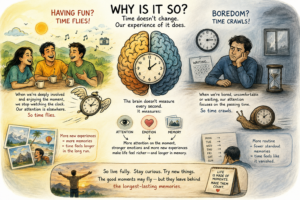
WHEN WE ARE HAVING FUN, WE STOP WATCHING THE CLOCK
When we are deeply involved in something enjoyable, our attention moves away from the passage of time.
We are concentrating on the conversation, the game, the movie, the book, the journey or whatever has captured our interest.
The less attention we give to time itself, the less we notice it passing.
That is why two hours spent with good company can suddenly produce the famous sentence:
“What? It’s already that late?”
Yes. It is.
The clock hasn’t betrayed you. Your brain simply wasn’t keeping score.
BOREDOM DOES THE OPPOSITE
Now put someone in a room with nothing interesting to do.
Suddenly every minute matters.
You look at the clock.
Five minutes later, you look again.
It feels as though the second hand has developed a personal grudge against you.
When we are bored, uncomfortable or waiting for something, our attention is much more likely to focus on the passage of time.
The result?
Time feels slower.
This is why waiting for a train, a delayed appointment or an important phone call can feel much longer than the same amount of time spent doing something enjoyable.
THERE IS ANOTHER TWIST
Things become even more interesting when we look back at an experience.
A holiday may feel as though it passed incredibly quickly while we were enjoying it.
But when we remember it later, a week filled with new places, people and experiences can seem surprisingly long.
Why?
Because our memory records events and changes, not every passing second.
A period filled with many new experiences gives the brain more memories to store. Looking back, it can therefore seem much richer and longer.
A routine week, on the other hand, may disappear from memory almost completely.
Monday, Tuesday, Wednesday…
And suddenly it’s Sunday again.
AGE MAY ALSO CHANGE OUR PERCEPTION OF TIME
Many adults have the feeling that years pass faster as they grow older.
There isn’t one simple explanation, but one possibility is that childhood contains a huge number of new experiences.
Your first day at school. Your first journey. Your first bicycle. Your first festival you truly remember. New friends, new places and new discoveries.
As we grow older, routines become more common.
When days look very similar, fewer experiences stand out in memory.
So looking back, a year packed with familiar routines may seem to have vanished surprisingly quickly.
CAN WE MAKE LIFE FEEL LONGER?
We obviously cannot slow the clock.
But we can change how richly we experience time.
Trying something new, visiting an unfamiliar place, learning a skill, meeting different people or simply breaking a routine creates new experiences for the brain.
In other words, a more varied life may feel richer when we look back on it.
So the next time someone says, “Where did the day go?”, don’t blame the clock.
The clock did exactly what it was supposed to do.
It was our attention—and our memory—that told a different story.
And that is the funny thing about time:
It never changes speed.
But somehow, our experience of it does.
WHY IS IT SO?
Because the brain doesn’t experience time like a stopwatch.
It experiences time through attention, emotion and memory.
So enjoy the good moments.
They may fly while you’re living them—but they can leave behind some of the longest-lasting memories.