
Why Is It So! Why Does Popcorn Pop?
Bilkul Online | Weekly Curiosity Column
Put a handful of corn kernels in a hot pan, add a little oil, cover it with a lid, and wait. Within minutes, the kernels begin jumping, crackling and bursting into fluffy white pieces.
It looks like a tiny kitchen fireworks show. But what makes a hard, yellow grain suddenly explode into something so light and crunchy?
The answer lies in three things: water, heat and pressure.
A Little Water Inside a Tiny Kernel
A popcorn kernel may look completely dry, but hidden inside it is a small amount of moisture. Its hard outer shell, called the hull, traps that moisture as the kernel heats up.
As the temperature rises, the water inside turns into steam. Steam occupies more space than liquid water, and the pressure inside the kernel begins to build.
Think of it as a miniature pressure cooker — except this one is preparing a snack.
When the Pressure Becomes Too Much
As the kernel heats further, the pressure continues to rise. The starch inside softens and becomes increasingly pliable.
At around 180°C, or 356°F, many popcorn kernels reach the point where their hull can no longer withstand the internal pressure. The shell ruptures, and the superheated moisture expands rapidly.
The softened starch puffs outward and then cools, forming the familiar white, airy structure we love to munch on.
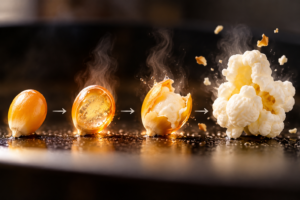
Pop! One hard kernel becomes a fluffy mouthful.
Why Doesn’t Ordinary Corn Pop Like This?
Not all corn is popcorn.
Popcorn varieties have a tough, relatively moisture-resistant hull and a starchy interior suited to expansion. When heated properly, they can build enough pressure to pop.
Sweet corn, the kind we often eat off the cob, has a different structure and composition. It doesn’t expand into the same fluffy shape under ordinary popcorn-making conditions.
So, although all popcorn is corn, not all corn can become popcorn. Nature has its own quality-control department.
Why Do Some Kernels Refuse to Pop?
Have you ever reached the bottom of a popcorn bowl and found a few stubborn kernels that remain hard?
These are often called old maids.
A kernel may fail to pop if its hull is cracked, allowing moisture to escape, or if it contains too little or too much moisture. Without the right balance, pressure may not build up enough for the kernel to burst properly.
That is why storing popcorn correctly matters. The ideal moisture level is crucial to the popping process.
The Final Pop
The next time you watch popcorn popping, remember that you’re witnessing a little lesson in physics and food science.
Heat turns water into steam. Pressure builds. The hull gives way. Starch expands.
And suddenly, a tiny grain becomes a snack that’s much bigger than the sum of its parts.
Who knew that a movie-night favourite could be such a spectacular experiment?
Bilkul! Now you know why.
Note: We seek Sponsors for this column. Please connect with us at infobilkul@gmail.com