At UNSC, India invokes 1943 Bengal Famine to warn of fallout from Ukraine conflict’s impact on food
United Nations
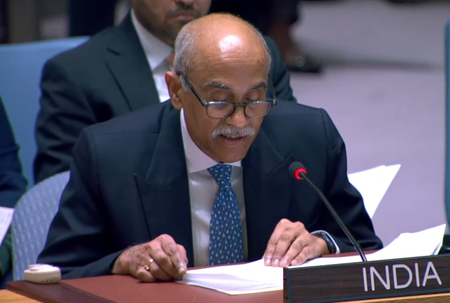
Invoking the searing memory of the 1943 Bengal famine that killed millions, India has warned that the Ukraine war’s disruption of global food supplies could have a similar devastating impact on the Global South. Russia’s and Ukraine’s “importance to global food security underscores how disruptions to agricultural production, maritime connectivity, and international trade can have consequences far beyond the immediate regions affected”, India’s Permanent Representative P Harish told the Security Council on Monday. “The pain and suffering caused by the devastating Bengal famine of 1943 in India that killed over three million people in India, is a stark reminder of the terrible human cost of a distant conflict caused by unchecked wartime priorities and calculations”, he said.
Drawing historical parallels, he said, “This current situation is not different from the time of the Second World War, when peoples not responsible for the start of the conflict became their unintended collateral damage”. “My Prime Minister [Narendra Modi] was firmly on the side of the Global South when he noted that this is not an era of war”, he said. “For the Global South, peace is not in the abstract. It is achieved when hungry mouths are fed”, he declared. Harish spoke at the Security Council discussion on “Protecting Critical Energy Infrastructure and Black Sea Lifelines of Global Food Supply”.
He reinforced the warning given by World Food Programme Executive Director Luke Lindberg that around ten million tonnes of Russian and Ukrainian wheat –enough to feed an estimated 44 million people — are blocked because of the escalating conflict. Lindberg said Somalia, for example, is at risk of famine because of this, and Yemen, which imports 90 per cent of its food, faces a dire situation.. During World War II, the British colonial rulers caused a famine by diverting food harvested in the Bengal region and destroying grain stockpiles to serve their faraway war goals, resulting in deaths of genocidal proportions. The dangers to food and agriculture in the Global South come on top of the consequences of energy shortages that have disproportionately hit the region, Harish said. “India has consistently emphasised that the causes of conflict are not shared equally.
CEPT University to Host Winter Exhibition 2026 from November 24
Global South countries are the most adversely affected by the food, fuel and fertiliser crisis caused by today’s global conflicts”, he said. Under-Secretary-General Rosemary DiCarlo, who briefed the Council, expressed concern that the conflict’s reverberations were felt beyond the area “with implications for food security far beyond the region”. She said, “In the Black Sea, drone attacks continue to threaten civilian navigation. The consequences extend far beyond the region, disrupting grain exports and other foodstuffs to countries in need”. Harish called on the Security Council to “prioritise humanitarian access, protection of civilian infrastructure and freedom of navigation” and ensure that humanitarian supplies are protected. “My country’s commitment to protection of Black Sea lifelines of global food supply is rooted in the appreciation that this region, just like my nation, is one of the food baskets of the world, the granaries of the Black Sea region and India combined account for almost a fifth of the global cereal production”, he pointed out.