
The Great Indians – Dr. Verghese Kurien
Verghese Kurien: The Man Who Turned India’s Milk Crisis into the White Revolution
The Visionary Who Empowered Millions
- Bilkul Online | Sunday Special
- By Rafat Quadri (Editor)
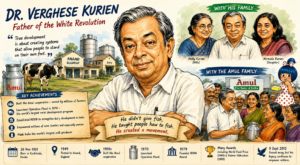
India’s journey from a milk-deficient nation to the world’s largest producer of milk is one of the most remarkable development stories of the 20th century. At the heart of this transformation stood Dr. Verghese Kurien, an engineer who neither came from a farming background nor initially intended to work in the dairy sector. Yet, through vision, innovation and an unwavering commitment to rural empowerment, he transformed the lives of millions of dairy farmers and changed India’s agricultural landscape forever.
Often referred to as the “Father of the White Revolution”, Kurien proved that sustainable development begins by empowering ordinary people. His work was not merely about increasing milk production—it was about restoring dignity, creating livelihoods and ensuring that farmers became owners of their own destiny.
Humble Beginnings
Verghese Kurien was born on 26 November 1921 in Kozhikode (then Calicut), Kerala, into a Syrian Christian family. His father, P.K. Kurien, was a civil surgeon, while his mother was well educated and encouraged intellectual curiosity from an early age.
Kurien studied physics at Loyola College, Chennai, before obtaining a degree in mechanical engineering from the College of Engineering, Guindy. He later received a government scholarship to study dairy engineering at Michigan State University in the United States.
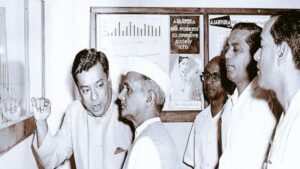
Ironically, dairy engineering was not his chosen career path. It was simply the field assigned to him under a government scholarship. Fate, however, had other plans.
The Reluctant Arrival in Anand
In 1949, after returning to India, Kurien was posted to a government creamery in the small town of Anand in Gujarat.
He disliked the assignment and intended to leave as soon as his mandatory government service ended.
During this period, he met Tribhuvandas Kishibhai Patel, a freedom fighter and cooperative leader who was working to organize local dairy farmers against exploitative middlemen.
Patel persuaded Kurien to stay and help build a farmer-owned dairy cooperative.
That single decision altered the course of Indian agriculture.
The Birth of Amul
The cooperative eventually became known as Amul, a name derived from the Sanskrit word Amulya, meaning “priceless.”
Kurien introduced professional management, modern processing technologies, scientific quality control and efficient supply chains.
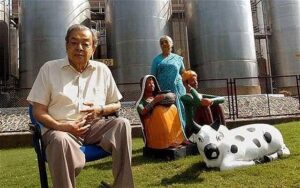
Unlike conventional businesses, Amul belonged to the farmers themselves.
Every litre of milk collected generated income directly for rural families rather than enriching private intermediaries.
This cooperative structure became one of India’s most successful economic models.
A Revolutionary Business Model
Kurien believed that prosperity should flow from villages to cities—not the other way around.
His three-tier cooperative model consisted of:
- Village dairy societies owned by farmers.
- District unions responsible for milk processing.
- State federations responsible for marketing products.
This ensured transparency, accountability and equitable distribution of profits.
The model later became a global case study in rural economic development.
Operation Flood: India’s White Revolution
In 1970, Kurien launched Operation Flood, one of the world’s largest rural development programmes.
The initiative connected milk producers across thousands of villages with urban consumers through a national milk grid.
Key achievements included:
- Creation of a nationwide cold-chain network.
- Scientific breeding programmes for cattle.
- Veterinary healthcare services.
- Artificial insemination facilities.
- Farmer training programmes.
- Stable pricing mechanisms.
- Modern dairy infrastructure.
Operation Flood dramatically increased milk production while reducing dependence on imported dairy products.
The programme fundamentally changed India’s food security.
More Than Milk: Empowering Rural India
Kurien’s greatest achievement was not simply producing more milk.
He transformed millions of small farmers—many owning just one or two cows—into entrepreneurs.
The cooperative movement generated:
- Stable household incomes.
- Financial inclusion through cooperative memberships.
- Better nutrition in rural communities.
- Educational opportunities for children.
- Improved healthcare access.
- Greater resilience against crop failures by providing a regular source of income.
Women, who traditionally cared for livestock, became active participants in village dairy societies and gained greater financial independence.
The Marketing Genius Behind Amul
Kurien understood that quality products alone were not enough.
Consumers also needed to trust the brand.
Under his leadership, Amul built one of India’s strongest consumer brands.
The now-iconic Amul Girl, introduced in the 1960s, became famous for witty advertisements commenting on current events.
The campaign continues today and is among the world’s longest-running advertising campaigns.
Kurien insisted that every advertisement reinforce Amul’s image as a trustworthy, farmer-owned brand.
Building Institutions That Outlived Him
Kurien believed that institutions matter more than individuals.
He was instrumental in establishing several landmark organizations, including:
- Gujarat Cooperative Milk Marketing Federation (GCMMF)
- National Dairy Development Board (NDDB)
- Institute of Rural Management Anand (IRMA)
IRMA, founded in 1979, was created to produce professional managers dedicated to rural development rather than solely corporate careers. It remains one of India’s leading institutions in rural management.
Leadership Style
Kurien was known for his blunt honesty, administrative discipline and fierce independence.
He resisted political interference and believed cooperatives should remain under the control of farmers rather than bureaucrats.
He often remarked that India did not need charity—it needed efficient systems that enabled people to help themselves.
His leadership combined technical expertise with a deep understanding of economics, governance and human behaviour.
Global Recognition
Kurien’s cooperative model attracted worldwide attention.
Governments and development agencies from Asia, Africa and Latin America studied the Amul model as an example of inclusive economic growth.
International experts regarded Operation Flood as one of the most successful agricultural development programmes ever implemented.
Awards and Honours
Throughout his career, Kurien received numerous prestigious honours, including:
- Ramon Magsaysay Award for Community Leadership (1963)
- Padma Shri (1965)
- Padma Bhushan (1966)
- Krishi Ratna Award (1986)
- World Food Prize (1989)
- Padma Vibhushan (1999)
These awards reflected not only his personal achievements but also the success of India’s cooperative movement.
Lesser-Known Facts About Verghese Kurien
- He Never Planned a Dairy Career
Kurien often joked that he entered the dairy industry by accident. His original interests lay in engineering, not agriculture.
- He Refused to Commercialize the Cooperative
Despite Amul’s success, he resisted proposals that would have diluted farmer ownership or converted the cooperative into a conventional private company.
- A Lifelong Belief in Professional Management
Kurien argued that cooperatives should be run with the same efficiency and accountability as the best private enterprises, while remaining owned by producers.
- He Encouraged Indigenous Capability
Instead of relying on imported dairy equipment, Kurien promoted Indian engineering and manufacturing, helping develop local expertise in dairy technology.
- Inspiration for Popular Culture
His life inspired filmmaker Shyam Benegal’s acclaimed 1976 film Manthan. The film was financed by contributions from over 500,000 dairy farmers—an extraordinary example of community-backed cinema.
- He Declined Lucrative Corporate Opportunities
Kurien remained committed to public service and the cooperative movement rather than pursuing more lucrative positions in private industry.
Legacy That Continues to Grow
Verghese Kurien passed away on 9 September 2012 at the age of 90, but his vision continues to shape India’s dairy sector.
Today, millions of farmers across India benefit from cooperative structures inspired by the Anand model. India’s position as the world’s largest milk producer stands as a testament to the institutions he built and the people he empowered.
His greatest legacy is not measured in litres of milk or financial turnover. It lies in the confidence he instilled in rural producers—that when farmers own the value chain, they can transform not only their own lives but also the destiny of a nation.
Five Inspiring Lessons from Verghese Kurien
- Real development begins by empowering people, not by creating dependency.
- Strong institutions create lasting change beyond individual leadership.
- Innovation is most meaningful when it improves ordinary lives.
- Integrity and professionalism can transform public systems.
- Great leadership is measured by how many others it enables to succeed.
Memorable Quotes
“India’s place in the sun would come from the partnership between wisdom of its rural people and the skill of its professionals.”
“I am like a buffalo. My skin is thick.”
“True development is not about charity; it is about creating systems that allow people to stand on their own feet.”
Timeline at a Glance
- 1921: Born in Kozhikode, Kerala.
- 1949: Posted to Anand, Gujarat.
- 1950s: Helped build the Amul cooperative.
- 1965: Became the founding chairman of the National Dairy Development Board.
- 1970: Launched Operation Flood.
- 1979: Founded the Institute of Rural Management Anand (IRMA).
- 1999: Awarded the Padma Vibhushan.
- 2012: Passed away, leaving behind one of India’s most enduring development legacies.
(Rafat Quadri can be reached at editorbilkul@gmail.com)
Photo Captions:
• Solo portrait of Dr. Verghese Kurien.
• Verghese Kurien with his family (wife Molly Kurien and daughter Nirmala Kurien).
• Verghese Kurien with the Amul family—interacting with dairy farmers and the cooperative movement he helped build. AI assitance used.