Rahul Gandhi in Pune: A Student Meeting That Became a Political Statement
Bilkul Online | Sunday Special
Pune
What was planned as a direct conversation between Rahul Gandhi and young women students in Pune quickly turned into a larger political spectacle, with questions of women’s freedom, education, social control, student politics and the future of India’s youth dominating both the stage and the debate outside it.
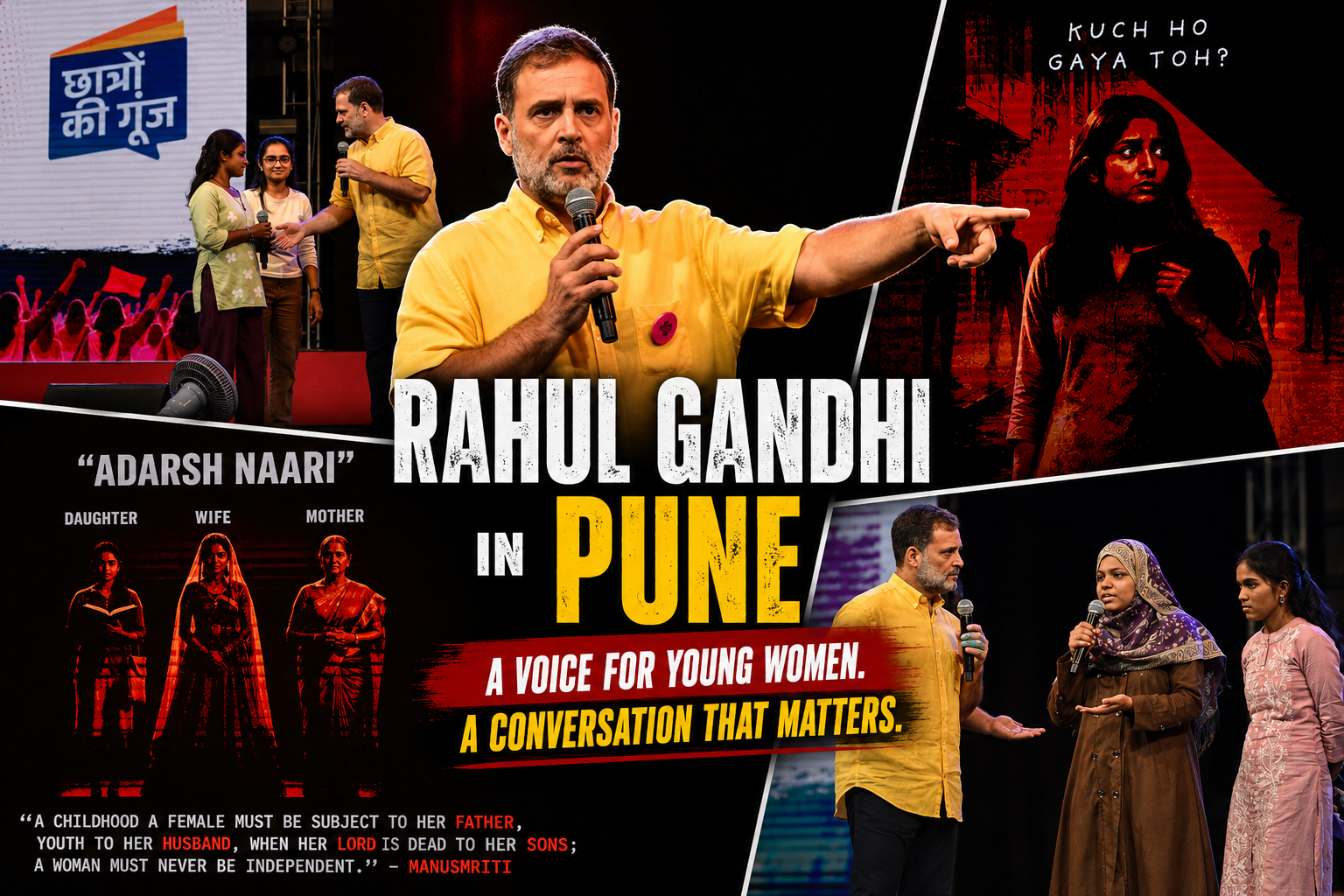
The Congress Leader of Opposition in the Lok Sabha addressed the Pune edition of “Chhatron Ki Goonj” on August 22, a youth outreach programme designed exclusively for girls. The choice of Pune was itself symbolic. Known as an important educational centre and closely associated with the legacy of social reformer and women’s education pioneer Savitribai Phule, the city provided an appropriate setting for Gandhi’s emphasis on women’s voices. Congress leaders had argued that conventional gender-neutral political gatherings often end up being dominated by men, and that the Pune programme was intended to give young women a platform to speak directly.
A different kind of political meeting
The atmosphere around the programme was noticeably different from a conventional political rally.
Rather than a large public meeting centred entirely on speeches, the event was presented as an interaction with students. Young women were given an opportunity to raise questions and discuss their experiences. The emphasis was on listening as much as speaking.
Gandhi repeatedly returned to the idea that women should be able to make their own choices without social or political control. He described India’s women as one of the country’s greatest strengths and argued that the country could not realise its full potential while women continued to face discrimination, harassment and restrictions.
He also spoke about the ways in which violence, disrespect and what may appear to be “concern” can become mechanisms for controlling women.
“Women belong to themselves”
One of the strongest themes of Gandhi’s address was women’s individual freedom.
He criticised patriarchal interpretations of the Manusmriti, arguing that such thinking attempts to place women within prescribed social boundaries. Gandhi told the gathering that no man has ownership or authority over a woman and urged young women to believe in themselves and resist attempts to confine them.
The message was clearly aimed at a younger generation that increasingly sees questions of personal freedom, gender equality and social identity as central to its understanding of politics.
Gandhi also linked the issue to the wider political environment, taking aim at the BJP and RSS and accusing them of supporting a patriarchal mindset. Those remarks ensured that what began as a student interaction also became a familiar Congress-BJP political contest.
Women’s experiences take centre stage
The interaction allowed the discussion to move beyond ideology.
Students raised concerns relating to harassment, discrimination and the difficulties faced by women in educational and public spaces. Gandhi spoke about violence against women and argued that violence is frequently used as a means of preventing women from advancing.
He also referred to the disproportionate effect that problems such as examination paper leaks and failures in the education system can have on young women, particularly those whose educational opportunities are closely tied to competitive examinations.
The presence of women on stage and the conversational character of the programme gave the meeting a more intimate feel than a conventional political rally.
The controversy outside the venue
But the Pune event did not exist in a political vacuum.
In the days before the programme, questions were raised over permissions and restrictions on gatherings. Police ultimately approved the event subject to 30 conditions, reflecting concerns over public order and the possibility of controversy.
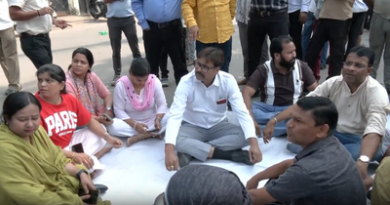
The political temperature rose further after a clash involving members of the ABVP and NSUI around the COEP campus ahead of Gandhi’s programme. Police complaints were filed by both sides, while reports said dozens of Youth Congress workers were booked following the confrontation.
The incident added another layer to an already politically charged student environment.
Perhaps most strikingly, a young woman who became part of the controversy subsequently indicated that she did not want to be drawn into political drama, saying she was not in a state of mind to meet or speak with Gandhi and did not want her situation used for political purposes. That episode underlined the sensitivity surrounding the event and the difficulties of keeping student issues separate from partisan politics.
BJP’s counterattack
The BJP was quick to challenge the Congress narrative.
Maharashtra Chief Minister Devendra Fadnavis alleged that the programme was not a spontaneous student gathering but a politically planned event intended to create controversy and provide Gandhi with a political “re-launch”. He also alleged that social-media influencers were paid to attend or promote the programme. These were political allegations, rather than established findings.
Maharashtra BJP vice-president Keshav Upadhye went further, describing the event as a “political comedy show” and alleging that students had been brought in college buses. The BJP argued that Gandhi had used a student programme to make political attacks rather than concentrating exclusively on student concerns.
Congress leaders, meanwhile, portrayed the criticism as evidence that the programme had succeeded in creating a national conversation around young women and their concerns.
The Pune ambience: education, politics and youth activism
Perhaps the most interesting aspect of the day was the setting itself.
Pune has long carried the image of an education city, but it is also a city with a strong tradition of political and social activism. The presence of Savitribai Phule in Pune’s historical memory gave the Congress event an additional symbolic dimension.
Outside the venue, however, the mood was far removed from a purely academic discussion. Security arrangements, political supporters, student organisations and competing narratives turned the programme into a highly watched political event.
There was also an effort by authorities to minimise disruption to the city. Traffic police monitored movement around the programme, while officials indicated that major road closures were not planned despite expectations of a large turnout.
The result was an unusual mix: a student interaction on the surface, a women’s rights discussion at its core and a political contest surrounding it.
More than a speech
Rahul Gandhi’s Pune appearance was therefore significant not simply because of what he said from the stage, but because of what happened around it.
For Congress, the event provided an opportunity to connect Gandhi directly with young women and position him around issues of equality, freedom and youth concerns.
For the BJP, the programme offered another opportunity to question the Congress leader’s political methods and motives.
For the students, however, the most important question was perhaps simpler: whether political leaders can create spaces where young people can speak about their everyday problems without those experiences immediately becoming ammunition in a larger political battle.
That tension — between student voice and political messaging — defined the Pune meeting.
And that may ultimately be the lasting image of “Chhatron Ki Goonj” in Pune: a programme that sought to amplify the voices of young women, but which simultaneously became a much bigger political conversation about who gets to speak, who gets heard and how much space India’s youth can claim in the country’s political discourse.
Kindly Like the shared link and Subscribe our channel. https://youtube.com/shorts/Kxi-NiFtB5Q?feature=share