
The Great Indians – SHAILENDRA — The Poet Who Put the Heart of India Into Its Songs
Shailendra (1923–1966)
Lyricist | Poet | Screenwriter | Producer
- Bilkul Online | Sunday Special
- By Rafat Quadri (Editor)
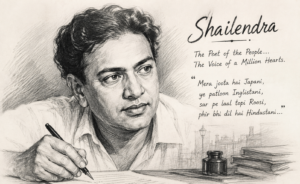
The fascinating story
Born Shankardas Kesarilal Shailendra on August 30, 1923, he came from a modest background and eventually moved to Bombay, where he worked with the Indian Railways. He wrote poetry on the side and became associated with the IPTA movement.
His life changed when Raj Kapoor heard him recite “Jalta Hai Punjab” at a mushaira. Kapoor wanted to use it in Aag, but Shailendra initially refused because he was reluctant to enter commercial cinema. Later, when he urgently needed money because his wife was expecting a child, he approached Kapoor. Kapoor was making Barsaat and gave him ₹500 for two songs.
That ₹500 assignment opened the door to one of the greatest creative partnerships in Hindi cinema.
Shailendra went on to write unforgettable songs for films such as Awaara, Shree 420, Anari, Guide, Sangam and many others. His writing had a rare quality: simple words, but profound thoughts. His songs could speak about love, poverty, loneliness, hope, philosophy and ordinary life without sounding artificial.
And then comes the heartbreaking second half of his story: Teesri Kasam.
Shailendra produced the 1966 film, based on Phanishwar Nath Renu’s Mare Gaye Gulfam, with Raj Kapoor and Waheeda Rehman. He poured enormous personal resources into the project. The film failed commercially, leaving him in severe financial difficulty. He died on December 14, 1966, aged only 43 — before Teesri Kasam received the National Award for Best Feature Film.
A man who wrote about the lives of ordinary people became one of India’s greatest lyricists — yet his own life ended in tragedy just as the work he believed in was beginning to receive recognition.
Raj Kapoor was the person who affectionately called Shailendra “Kaviraj” and also “Pushkin,” after the great Russian poet Alexander Pushkin. Shailendra’s son has recalled that Raj Kapoor would address his father as Kaviraj or Pushkin.

Four songs that reveal the real Shailendra
- “Awaara Hoon” — Awaara (1951)
“Awaara hoon… ya gardish mein hoon aasman ka tara hoon…”
This sounds like the declaration of a carefree wanderer, but beneath it is the loneliness and uncertainty of the common man. Shailendra could take poverty, displacement and insecurity and turn them into something almost universal. His lyrics repeatedly reflected the struggles of ordinary people.
- “Mera Joota Hai Japani” — Shree 420 (1955)
“Mera joota hai Japani, ye patloon Inglistani…”
And then comes the unforgettable thought:
“Sar pe lal topi Roosi, phir bhi dil hai Hindustani.”
It is playful, patriotic and philosophical at the same time. The clothes may be foreign, but the heart remains Indian. That extraordinary ability to say something profound in language that everyone could understand was one of Shailendra’s trademarks.
- “Aaj Phir Jeene Ki Tamanna Hai” — Guide (1965)
“Aaj phir jeene ki tamanna hai, aaj phir marne ka iraada hai…”
Here Shailendra moves from the street to the human heart. The song is about breaking free, rediscovering oneself and choosing life again. Guide contained several of his finest pieces, including “Aaj Phir Jeene Ki Tamanna Hai,” “Din Dhal Jaaye,” “Piya Tose” and “Tere Mere Sapne.”
- “Sajan Re Jhooth Mat Bolo” — Teesri Kasam (1966)
“Sajan re jhooth mat bolo, khuda ke paas jaana hai…”
This one is particularly poignant because Teesri Kasam was Shailendra’s own production. He put his money, reputation and enormous emotional energy into the film. The production dragged on for years and its commercial failure left him deeply distressed and financially burdened. His health deteriorated; accounts also describe heavy drinking and depression during this period.
And there is an almost haunting irony here: the film that contributed so heavily to his personal downfall later won the President’s Gold Medal/National Award for Best Feature Film — after his death.
So, what made him THE SHAILENDRA?
He did not write down to the common man. He wrote for the common man.
At a time when Hindi cinema had some extraordinarily sophisticated Urdu poets and lyricists, Shailendra’s special gift was the eloquence of an uncomplicated thought. His words were often deceptively simple, but underneath them were ideas about poverty, love, loneliness, dignity, hope, morality and life itself.
And perhaps that is why “Kaviraj” was such an appropriate name.
Raj Kapoor wasn’t merely calling him a lyricist. He was acknowledging the poet in him.
There is also something deeply moving about the fact that Shailendra’s own life increasingly resembled the emotional world of his songs. He knew poverty, struggled for recognition, suffered disappointment, experienced financial ruin, and went through a period of depression and deteriorating health. Yet he left behind songs that continue to give hope, dignity and courage to millions.
Shailendra spent his life giving words to the joys and sorrows of ordinary Indians. In the end, those words outlived the man who wrote them.
And I think that is what made him Shailendra.
The Great Indians | Bilkul Online
Celebrating Indians whose work has shaped the way we think, create, build and live. You can also suggest names of individuals/institutions present or past.
Note: We seek Sponsors for this column. Please connect with us at infobilkul@gmail.com