
The Great Indians – Eknath Vasant Chitnis
- Bilkul Online | Sunday Special
- By Rafat Quadri (Editor)
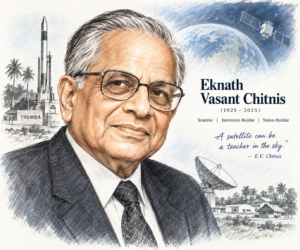
Before India became a space power, a small group of scientists laid the foundations. Among them was Eknath Vasant Chitnis—a man whose work connected Vikram Sarabhai’s vision, a young A.P.J. Abdul Kalam and, eventually, millions of Indians in remote villages.
Born in Kolhapur in 1925, Eknath Vasant Chitnis grew up in difficult circumstances after losing his parents at a young age. He studied in Pune and eventually pursued science, building a career that would take him into the heart of India’s emerging space programme. His journey began at the Physical Research Laboratory (PRL) in Ahmedabad, where he came into contact with Dr Vikram Sarabhai.
A partnership that changed India’s space story
In the early 1960s, India was only beginning to explore the possibilities of rockets and space science. Sarabhai needed people who could turn his ambitious ideas into practical projects. Chitnis became one of his key associates.
In 1961, Chitnis returned from the United States at Sarabhai’s request and helped establish India’s early satellite telemetry work. He later became Member-Secretary of the Indian National Committee for Space Research (INCOSPAR), the organisation that eventually evolved into ISRO.
One of his most important assignments was finding a suitable location for India’s first rocket-launching station.
His team eventually selected Thumba, near Thiruvananthapuram in Kerala. The location was scientifically ideal because it was close to the Earth’s magnetic equator. At the time, however, Thumba was little more than a fishing settlement with an old church and thatched huts. The land was acquired with the cooperation of local authorities and the Bishop of Trivandrum.
On 21 November 1963, India’s first sounding rocket, the Nike-Apache, was launched from Thumba. It was a modest beginning—but it marked the start of a journey that would eventually take India to the Moon and Mars.
The scientist who spotted Kalam’s potential
There is another remarkable chapter in Chitnis’s story.
A young aerospace engineer named A.P.J. Abdul Kalam was looking for an opportunity to work in India’s space programme. Chitnis recognised his potential and helped bring him into the emerging programme. Kalam was subsequently selected for training in the United States.
The young engineer would go on to become one of India’s most celebrated scientists and eventually the 11th President of India. Chitnis’s contribution was not simply technical—he had an eye for talent and the confidence to give young scientists an opportunity.
When the satellite became a teacher
Perhaps Chitnis’s most visionary contribution came later.
He understood that India’s space programme should not be only about rockets and scientific achievement. Space technology had to improve the lives of ordinary Indians.
As Director of the Space Applications Centre in Ahmedabad, Chitnis played a leading role in the Satellite Instructional Television Experiment (SITE) in 1975–76.
Using NASA’s ATS-6 satellite, educational and development programmes were beamed to around 2,400 villages across six states. Television was being used not merely for entertainment, but for education, agriculture, health and social development.
Chitnis described the idea beautifully: the satellite could become “a teacher in the sky.”
The success of SITE demonstrated how communication satellites could help bridge India’s enormous geographical divide and contributed to the thinking that eventually shaped India’s INSAT system.
A life beyond the laboratory
Chitnis continued to champion communication technology and education even after his major space-programme assignments. He later taught for decades at Pune University, believing strongly in engaging with young minds.
His contributions were recognised with the Padma Bhushan in 1985. He also served on the Board of Directors of the Press Trust of India and twice served as its chairman.
Chitnis lived to be 100, passing away in Pune on October 22, 2025.
The lesson from Eknath Vasant Chitnis
India’s space story is often told through the names of Sarabhai, Kalam and later generations of scientists. But institutions are rarely built by one person.
Chitnis was one of those builders.
He helped find the ground from which India’s rockets would rise, recognised the potential of a young Kalam, and helped demonstrate that satellites could serve India’s villages.
His story reminds us that greatness is not always about being the person standing in front of the camera. Sometimes, it is about recognising an opportunity, building the institution and giving others the chance to make history.
And that is precisely why Eknath Vasant Chitnis deserves his place among The Great Indians.
Note: We seek Sponsors for this column. Please connect with us at infobilkul@gmail.com