Kalpasar Project: Gujarat’s Ambitious Plan to Create a Freshwater Reservoir Across the Gulf of Khambhat
BilkulOnline Explainer
A proposed dam could transform water availability in Saurashtra, shorten travel between Bhavnagar and Surat, and create opportunities for renewable energy—but the mega-project remains under planning.
Gujarat’s ambitious Kalpasar Project is once again in focus as the state advances the planning of a massive dam across the Gulf of Khambhat, aimed at creating a freshwater reservoir while improving regional connectivity and exploring renewable-energy potential.
The project, officially known as the Gulf of Khambhat (Kalpasar) Project, is envisioned as a major infrastructure initiative that could address water scarcity in parts of Saurashtra while connecting regions on either side of the Gulf.
What is the Kalpasar Project?
The basic idea is to construct a large dam or dyke across the Gulf of Khambhat to create a reservoir capable of storing freshwater flowing from rivers into the region.
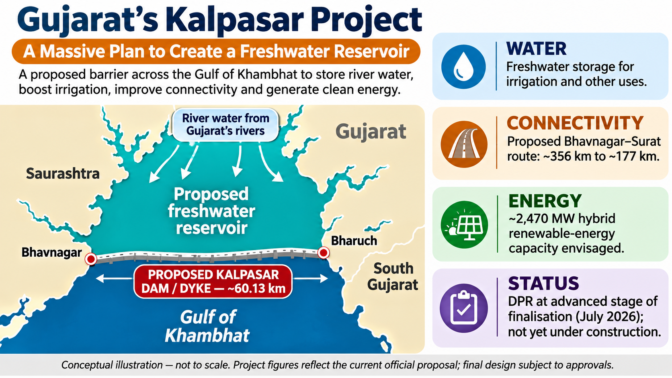
The proposed structure would extend approximately 60.13 kilometres, including the marine section and connecting portions on both sides. The reservoir is intended to help supply water for irrigation and other uses in water-stressed areas of Gujarat.
The project is also designed as a multipurpose infrastructure development rather than simply a water-storage scheme.
Why does Gujarat need it?
Water scarcity has been a long-standing challenge in several parts of Gujarat, particularly Saurashtra. Rainfall is unevenly distributed, and agricultural and industrial demand places pressure on available water resources.
The Kalpasar concept aims to capture and store freshwater that would otherwise flow into the sea and make it available for use in water-deficient regions.
The project is expected to support irrigation, improve water availability and potentially strengthen drinking-water and industrial supply systems.
How could it change connectivity?
One of the most significant features of the project is a proposed highway-cum-rail corridor over the dam.
According to the latest information provided by the Government of India, the proposed corridor could reduce the road distance between Bhavnagar and Surat from approximately 356 kilometres to around 177 kilometres.
That could improve connectivity between Saurashtra and South Gujarat, potentially reducing travel time and supporting trade, tourism and regional economic activity.
Could Kalpasar also generate energy?
The project’s current planning includes the possibility of developing approximately 2,470 MW of hybrid renewable-energy capacity on reclaimed land that is presently submerged during high tide.
The energy is envisaged to support, among other uses, pumping freshwater for irrigation in coastal regions of Saurashtra.
The proposal also requires careful engineering to address salinity, tidal conditions, coastal dynamics and environmental concerns.
What is the current status?
The Kalpasar Project has been discussed for decades and has faced major technical, environmental, financial and planning challenges.
As of the latest official update in July 2026, the Detailed Project Report (DPR) was at an advanced stage of finalisation.
India and the Netherlands are also working on technical cooperation involving expertise in coastal engineering, hydraulic modelling, salinity management, climate resilience and water management.
However, the project has not yet moved into full-scale construction. The DPR, necessary approvals and other clearances will be critical before implementation can proceed.
The big question
If implemented, Kalpasar could become one of Gujarat’s most ambitious water and infrastructure projects, potentially bringing together freshwater storage, irrigation, transport connectivity and renewable energy.
But the scale of the project also means that its final cost, environmental impact, engineering feasibility, water-management strategy and timeline will need careful evaluation.
For Gujarat, the promise is enormous. The challenge will be turning a decades-old vision into a technically viable and sustainable project.
- AI Job Fears Push Gujarat Students Towards Core Engineering Courses
- Gujarat: Fit India’s ‘Sundays on Cycle’ marks 100th edition, Ahmedabad to host flagship event