
The Great Indian: Irshad Kamil – The Poet Who Turns Emotions Into Timeless Songs
Bilkul Online | Sunday Special
The Magic of Irshad Kamil: When Bollywood Lyrics Become Poetry
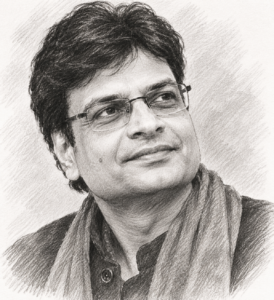
From the restless rebellion of Rockstar to the tenderness of Jab We Met, Irshad Kamil has turned ordinary words into extraordinary emotions, creating songs that do more than entertain—they stay with us.
There are lyricists who write songs that become hits, and then there are lyricists whose words become part of people’s lives. Irshad Kamil belongs to the latter category. His songs have accompanied first love, heartbreak, journeys of self-discovery, quiet moments of reflection and the kind of longing that is difficult to explain but easy to feel.
In an industry where music often competes for instant attention, Kamil’s words possess a rare quality: they invite listeners to pause, think and feel. Whether it is the exuberance of Mauja Hi Mauja, the tenderness of Tum Se Hi, the spiritual intensity of Kun Faya Kun, the rebellion of Sadda Haq or the heartbreaking vulnerability of Agar Tum Saath Ho, his writing demonstrates that a song can be simultaneously popular, poetic and deeply personal.
Born in Malerkotla, Punjab, Irshad Kamil’s journey to Bollywood was not a straightforward one. A student of literature, he pursued journalism and worked with newspapers in Chandigarh before moving to Mumbai to follow his creative calling. His academic grounding in Hindi literature, his familiarity with Urdu poetry and Punjabi culture, and his early engagement with theatre and writing shaped the sensibility that would eventually make him one of Hindi cinema’s most distinctive lyricists.
His entry into films through Chameli introduced audiences to a writer who was not interested in merely decorating a melody with words. Songs such as Bhaage Re Mann revealed an ability to capture the complicated inner life of a woman, giving music a psychological depth that went beyond conventional romantic expression.
Words that became memories
Some of Irshad Kamil’s most memorable work is inseparable from the films and characters for which he wrote.
In Jab We Met, he gave love an effortless, everyday warmth. Tum Se Hi became an anthem for the feeling that another person has quietly transformed the world around you. Mauja Hi Mauja captured carefree joy, while Aao Milo Chalo celebrated the romance of companionship and travelling without a destination.
With Love Aaj Kal, Kamil explored love across generations and changing emotional landscapes. Ajj Din Chadheya became a prayer-like expression of love, while Chor Bazari brought playful, mischievous energy to romance. His ability to move between sincerity and humour without losing his lyrical identity is one of his defining strengths.
Then came Rockstar, a film whose emotional universe found an extraordinary voice in Kamil’s words. Nadaan Parindey spoke of the yearning to return home and discover oneself. Jo Bhi Main carried the confusion, frustration and defiance of a restless artist. Sadda Haq transformed individual rebellion into a collective cry, while Kun Faya Kun brought spiritual surrender and transcendence into popular cinema.
Few lyricists could move so naturally from the raw energy of a protest anthem to the meditative beauty of a spiritual composition within the same film.
His work in Highway brought another dimension to his writing. Patakha Guddi, with its earthy Punjabi spirit and exuberant sense of freedom, became an expression of liberation. It was not simply a song about travelling; it captured the sensation of breaking away from the life one has known.
In Tamasha, Kamil’s lyrics explored identity, imagination and the struggle to live beyond the roles imposed by society. Agar Tum Saath Ho remains one of Hindi cinema’s most emotionally powerful songs about love, separation and the inability of two people to completely understand each other. Its words are restrained, but the emotions beneath them are enormous.
His lyrical universe has also extended to songs such as Heer Toh Badi Sad Hai, Bekhayali, Dil Diyan Gallan, Maahi Ve, Tu Hai To Main Hoon, Vida Karo and more recent film compositions, demonstrating his ability to remain relevant across changing musical eras.
The uniqueness of his art: simplicity with depth
What distinguishes Kamil is not simply his vocabulary, but his ability to make complex emotions sound uncomplicated.
He frequently draws from Hindi, Urdu and Punjabi, blending them without making the language feel forced. His Punjabi influences are not merely decorative; they bring cultural authenticity, rhythm, imagery and a distinctive emotional texture to his songs. His words can be conversational and contemporary one moment, and philosophical or spiritual the next.
He understands that a powerful lyric does not necessarily require difficult words. Sometimes, the simplest expression carries the deepest meaning. His writing often begins with an ordinary thought, a familiar phrase, a memory, a conversation or an image—and then gives it an unexpected emotional dimension.
This is particularly evident in songs such as Safarnama, which is not merely about travel but about the possibilities of becoming a different person; Jo Bhi Main, which reflects the frustration of trying to express oneself; and Kun Faya Kun, where spiritual devotion becomes an experience of surrender and self-discovery.
Kamil’s strength also lies in his understanding of the character for whom he is writing. His lyrics do not always sound like the voice of the lyricist; they sound like the voice of the character. A rebellious young musician, a carefree traveller, a heartbroken lover, a historical figure or someone searching for meaning—each can inhabit a different lyrical world.
This character-driven approach has made his collaborations with filmmaker Imtiaz Ali particularly memorable. The songs in their films often become an extension of the characters’ thoughts, revealing what dialogue cannot.
Punjab: the soil beneath his poetry
The cultural landscape of Punjab remains a recurring influence in Kamil’s work. The memories of Malerkotla, its neighbourhoods, people, traditions, folk expressions and the linguistic richness of the region continue to find their way into his writing.
His lyrics often carry the warmth of lived experiences rather than the artificiality of manufactured imagery. A phrase heard in a neighbourhood, an expression used by an elderly woman, a memory from childhood or an observation about ordinary life can become the seed of a song.
That ability to transform personal and cultural memory into something universally relatable is perhaps one of the most remarkable aspects of his artistry. Listeners who may never have visited Punjab can still connect with the emotion, the longing, the joy and the nostalgia embedded in his songs.
In recent work, including Amar Singh Chamkila and Main Vaapas Aaunga, his engagement with Punjab’s history, cultural memory and collective experiences has become particularly evident. His writing continues to move between contemporary emotions and the deeper roots of poetry, folk traditions and spiritual thought.
A lyricist who refuses to remain in one genre
Kamil’s versatility is another reason his body of work stands out.
He has written romantic songs, dance numbers, devotional compositions, rebellious anthems, folk-inspired tracks, philosophical songs and emotionally intense ballads. Yet, despite the variety, there is an unmistakable lyrical sensibility running through his work.
He can write the exuberant Nagada Nagada and the soulful Ajj Din Chadheya. He can move from Patakha Guddi to Kun Faya Kun, from Sadda Haq to Agar Tum Saath Ho, and from playful romance to existential reflection without appearing to repeat himself.
His writing has also evolved with changing generations. As musical styles, listening habits and the language of young audiences have transformed, Kamil has continued to find ways to communicate contemporary emotions without sacrificing poetic integrity. He has spoken about his insistence on emotional truth, saying that he cannot manufacture or fake feelings in his writing.
Beyond the hit song
For Irshad Kamil, success is not merely measured by a song’s popularity, its streaming numbers or its place on a playlist. His work suggests a deeper ambition—to create words that people recognise as their own emotions.
A song may be written for a film, composed to a melody and performed by a singer, but once it reaches the listener, it begins a life of its own. It becomes someone’s memory of a college romance, a road trip, a lost relationship, a difficult period in life or a moment of spiritual awakening.
That is the enduring power of his writing.
His songs are not always about finding answers. Often, they are about asking questions, accepting contradictions and acknowledging that human emotions rarely fit into neat categories. Love can be beautiful and painful at the same time. Freedom can be exhilarating and frightening. A journey can take us away from home while bringing us closer to ourselves.
And perhaps that is why Irshad Kamil’s words continue to resonate.
He is not simply writing lyrics for Bollywood. He is giving language to feelings that millions of people carry within them but cannot always articulate.
In the Great Indian story of creativity, Irshad Kamil represents the enduring power of the written word—a reminder that when poetry meets music, a few carefully chosen words can outlive the film, the melody and even the moment in which they were first heard.