IIMA’s Gold Markets Conference 2026 Focuses on Tech-Driven Transformation of India’s Gold Economy
- Bilkul Online
-
- Ahmedabad | 25 May 2026
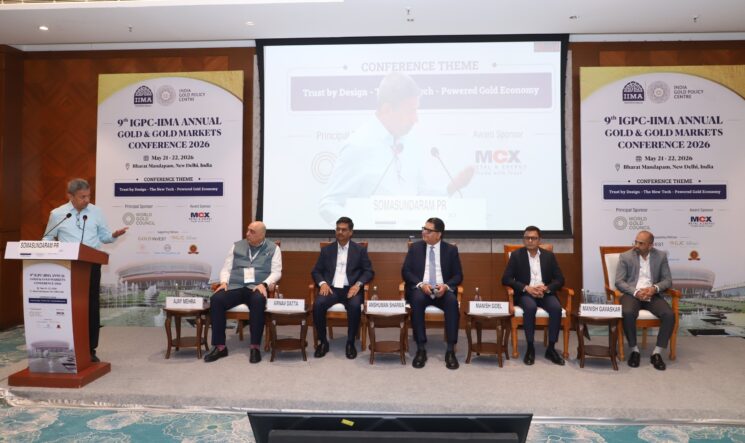
The India Gold Policy Centre (IGPC) at the Indian Institute of Management Ahmedabad organised the 9th edition of the IGPC-IIMA Annual Gold and Gold Markets Conference 2026 at Bharat Mandapam, New Delhi, bringing together policymakers, academicians, industry leaders, jewellers, refiners, and financial experts to discuss the future of India’s gold economy.
Held on May 21 and 22, the conference revolved around the theme ‘Trust by Design – The New Tech-Powered Gold Economy’, focusing on technology-driven governance, digital transformation, evolving global gold markets, and reforms needed to unlock the sector’s full economic potential.
The conference was inaugurated by Professor Bharat Bhasker, Director of IIMA; Professor Sundaravalli Narayanaswami, Chairperson of IGPC; Amit Singla from the Department of Economic Affairs, Ministry of Finance; and Sachin Jain, India CEO of the World Gold Council. Dr. Sridhar Vembu, Chief Scientist at Zoho Corporation, and Dr. Hasmukh Adhia, Principal Advisor to the Chief Minister of Gujarat, attended as Chief Guests.
Addressing the gathering, Dr. Hasmukh Adhia highlighted the importance of gold financialisation and strategic policymaking. “India must strengthen its ability to influence global gold pricing while ensuring that reactionary policymaking does not create long-term disruptions in the sector,” he said.
Dr. Sridhar Vembu stressed the need for indigenous technological innovation in the bullion ecosystem. “Trust cannot be created only through regulations. It has to be embedded across systems and institutions if gold is to contribute meaningfully to India’s economic growth,” he remarked.
Professor Bharat Bhasker noted that the conference served as an important platform for collaborative policy dialogue. “Gold continues to play a vital role in India’s economy, especially amid global uncertainty, and such discussions are essential to understand how the sector can contribute more effectively to national growth,” he said.
Professor Sundaravalli Narayanaswami described the Indian gold industry as being at a crucial phase of structural transformation. She proposed several reforms, including a unified bullion import channel, a Gold Trust of India for formalising household gold, and a dedicated ministry or entity such as ‘Swarn Shakti’ for policy coordination. “The larger objective should be to position India as the Gold Capital of the World and evolve into a two-way price setter country,” she said.
The conference also featured keynote addresses from industry experts, including Sachin Jain of the World Gold Council, who spoke about India’s emerging role in the global gold landscape, and representatives from Crisil Ratings and MCX, who discussed trust-building, governance, and technology-led market infrastructure.
Six panel discussions and multiple academic paper presentations explored issues such as digital and tokenised gold markets, changing consumer behaviour, trade policy reforms, self-regulation, supply chain disruptions, and geopolitical challenges impacting the global gold economy.